
John Chalmers Threepence, Sixpence, and Shillings
In the years immediately after the American Revolution, commerce in the Mid-Atlantic still depended heavily on whatever coin happened to be available. Spanish silver circulated widely, but much of it was underweight, worn, or literally cut into smaller segments to make change. Cut pieces worked in the short term but caused problems later. Cuts were not always even, value was debated, and each division tended to shed small amounts of metal. For merchants trying to price goods and settle accounts consistently, small silver in reliable units was in short supply.
In Annapolis, Maryland, John Chalmers, a working gold and silversmith, responded in a practical way. Instead of waiting for outside help, he struck silver pieces that circulated on the strength of his name. In 1783, Chalmers produced a set of denominational issues that included a threepence, two distinct sixpence varieties, and multiple shilling varieties. The coins show uneven strikes typical of small shops, yet the designs are clear and suited to daily use.
A Local Answer to a Small Change Crisis
Chalmers was not inventing demand. He was responding to an environment where customers hesitated to accept questionable Spanish fragments and where making change could be a negotiation. His own name on the coin served as a guarantee. Chalmers was known in Annapolis and had public ties that strengthened confidence. Tradition notes his service in the Continental Army and his civic role in Annapolis government, roles may have helped locals view his name on the coinage as a sign of accountability. In a community where trust mattered, that recognition helped his silver trade more freely than anonymous cut coin.
The practical nature of the project also explains why a fellow artisan may have been involved. The coinage is commonly associated with Thomas Sparrow, another Annapolis silversmith who is often credited with engraving dies for the series. Sparrow’s initials TS are documented on the sixpence design, and some references suggest he likely assisted with striking, but the threepence itself does not typically show TS. Whether Sparrow struck all denominations or only certain pieces, the collaboration reflects a local workshop solution to a local monetary problem.
Types, Devices, and the Rare Congressional Pattern
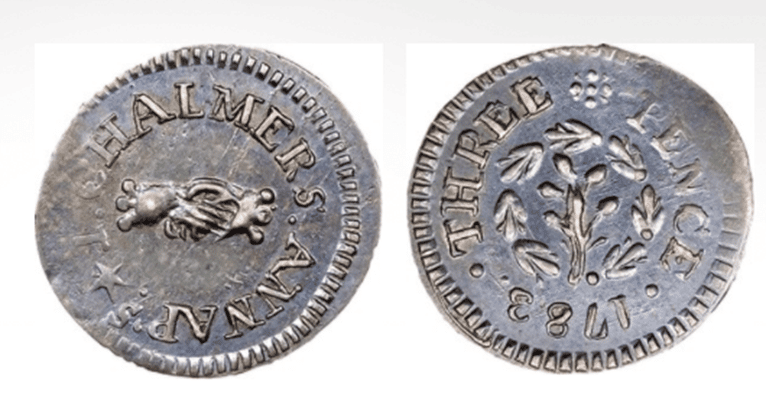
The threepence is among the most straightforward to describe. Its obverse shows two clasped hands as the central device, with a surrounding inscription naming the issuer and location, “J. CHALMERS. ANNAP” with punctuation and stars seen on many pieces. The reverse depicts a tree branch encircled by a wreath, with the denomination and date around the edge, “THREE PENCE 1783”. The overall look is simple and symbolic: agreement and honest dealing on one side, a clean denomination on the other.
The sixpence is often summarized in two headline varieties, Small Date and Large Date, although specialists also recognize multiple die marriages within those groupings. One side displays a star within a wreath, with the issuer and place around it, “J. CHALMERS ANNAPOLIS”. The other side shows a cross with clasped hands at the crossbars, and some examples include stars and crescents at the ends of the cross. The inscription includes SIX PENCE and 1783, often with the initials I.C.
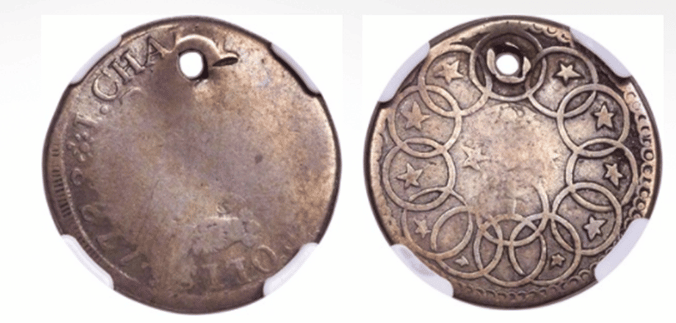
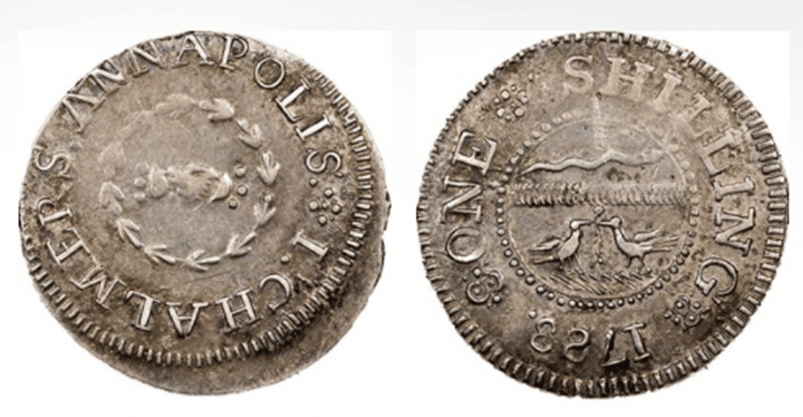
The shillings form the most detailed coins in the series. The obverse returns to the clasped-hands motif paired with “J. CHALMERS ANNAPOLIS”. The reverse presents two doves competing for a worm beneath a hedge, while a snake waits in the background. The denomination “ONE SHILLING 1783” circles the scene. Collectors describe the birds shillings in Long Worm and Short Worm varieties, which are variations within the same birds, hedge, worm, and snake design. Separately, an extremely rare Rings shilling uses a different reverse concept altogether and ranks among the rarest Chalmers pieces.
Chalmers also produced a very rare shilling type that some researchers interpret as a pattern or proposal piece connected to the period when Congress met in Annapolis from late 1783 into 1784. The idea that it was meant to impress Congress is plausible but not firmly documented. Only a handful survive. Its obverse reads “J. CHALMERS ANNAPOLIS 1783”, with “EQUAL TO ONE SHI” written centrally. On the extremely rare Rings shilling, the birds scene is replaced by a different reverse featuring linked rings, stars, and an all-seeing eye, with additional symbolism that some descriptions interpret as a liberty pole and cap. This rings design is generally treated as the rare alternative reverse type within the Chalmers shilling series. It shows that Chalmers’s coinage aimed at commerce and at national recognition.