
Libertas Americana Medals and the Birth of American Numismatic Symbolism
In the early years of the United States, money was as much a political problem as an economic one. The new nation lacked a mature minting system, relied heavily on foreign coinage, and was still developing a visual language to express independence. In that environment, medals played a special role. They were not meant to circulate, but they could communicate power, alliances, and national identity in a durable form. The Libertas Americana medal, struck in France, is a well-documented commemorative of American independence and of the Franco-American alliance during the Revolution.
Collectors often call it the “1781” Libertas Americana because one inscription memorializes Yorktown (1781), but the medal also includes dates for American independence (1776) and Saratoga (1777). The concept was developed in 1782 and the original medals were struck in Paris in 1783. The 1783 date shows the medal was a retrospective celebration meant to highlight American victory and French support.
Origins and Purpose
The Libertas Americana medal began with Benjamin Franklin during his service in France as America’s minister. Franklin wanted a piece that could function as a diplomatic symbol and a cultural statement, reinforcing goodwill toward the United States and acknowledging French support. In a March 4, 1782 letter to Robert R. Livingston, the U.S. Secretary for Foreign Affairs, Franklin described his idea for a medal commemorating recent American victories and France’s role in them.
Work on the design involved prominent French artists and engravers. The medal is closely associated with Augustin Dupré, who engraved key elements and whose name appears on the piece, while the reverse concept is often linked to Esprit-Antoine Gibelin. However one assigns the precise division of labor, the overall result is a Franco-American creation, conceived by Franklin and executed by elite French medallic talent.
The medal doubled as a diplomatic gift. Records indicate two gold pieces were reserved for Louis XVI and Marie Antoinette, while Franklin gave silver examples to French officials and colleagues. Franklin used the piece as both a commemorative object and a tool of statecraft.
Symbolism and Design
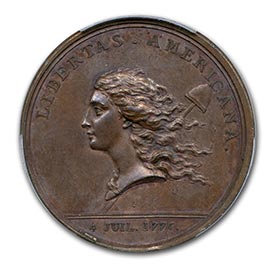
The obverse presents Liberty as a classical female bust with flowing hair, paired with the inscription LIBERTAS AMERICANA. The design influenced later American imagery, including the Liberty motifs on early U.S. coins and medals. Many numismatists view this as one reason the medal matters beyond its immediate historical moment: it contributed to what Liberty looked like in American material culture.
A leonine figure of Britannia represents Britain, while Minerva (France) helps protect the infant Hercules (America) as he overcomes two serpents. Franklin’s explanation of the symbolism ties the two serpents to major British armies defeated at Saratoga and Yorktown, turning military history into an easily read image.
The medal also anchors its message in dates, linking American independence and key victories into a single narrative arc. The blend of classical allegory and dated victories gives the Libertas Americana lasting historical and collecting interest.
Legacy and Collectability
Original Libertas Americana medals were struck in 1783 in bronze/copper and silver, with two gold pieces made for presentation. Exact mintages are unknown; research suggests around 100 bronze pieces and 30 silver pieces survive, while the two gold pieces are historically reported but not known to survive. Later restrikes by the Paris Mint and others exist in multiple metals and formats, but collectors typically treat original 1783-era strikes as the core of the series.
Given their historical importance and relative rarity, especially in silver, Libertas Americana medals often realize high prices at major auctions, though results vary widely by metal, condition, and provenance. In the market, they are often collected alongside other early American medals and patterns as foundational objects that helped define the visual identity of the United States before a full national coinage system was firmly established.