
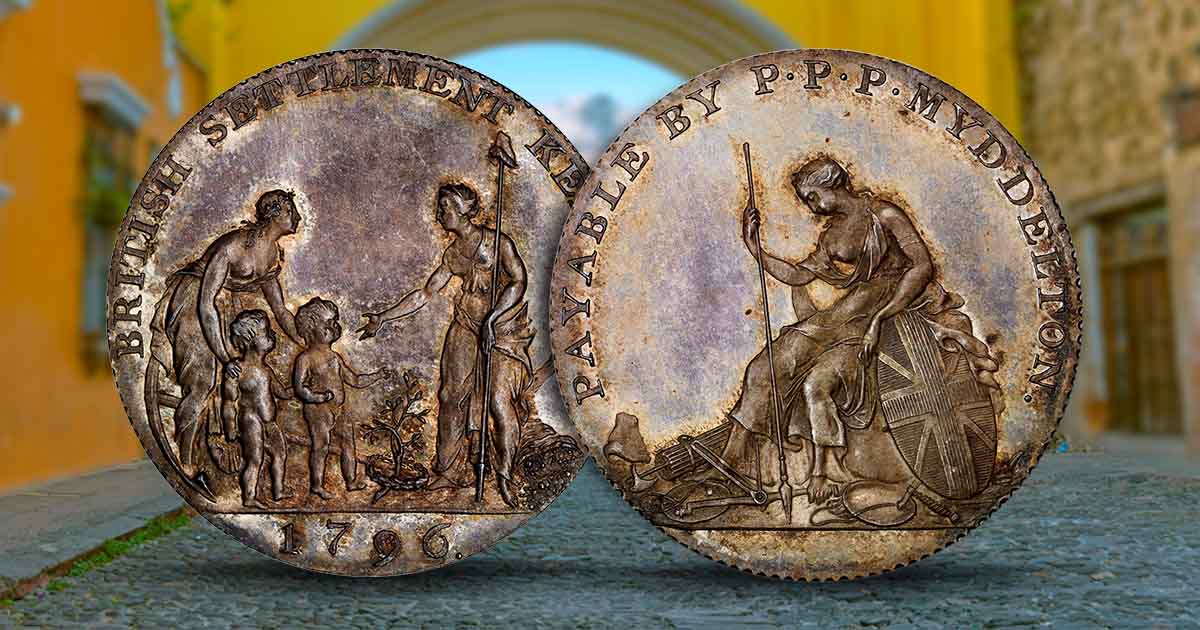
Myddleton Tokens of 1796: Planned but Never Circulated
Myddleton Tokens dated 1796 are a noted, story-rich issue in early Anglo-American token collecting, largely because their intended purpose was disrupted before the plan could be carried out. They are commonly linked to Philip Perry Price Myddleton, an Englishman who acquired a large tract of land along the Ohio River in Kentucky and promoted it as the foundation for a productive farming community. He hoped to attract laborers and settlers with the promise of steady work and a better life. He planned a local economic system that would function with minimal friction.
In practice, the plan ended before it could take root. Myddleton was convicted in England of “enticing artificers to emigrate” and was sentenced to a £500 fine and 12 months’ imprisonment (or until the fine was paid). He remained imprisoned for more than three years, finally paying the fine in November 1799. He next turns up in England in 1806, defending himself in another lawsuit, leaving it uncertain whether he ever reached America at all. The tokens that were meant to support his Kentucky venture therefore became artifacts of an abandoned venture rather than instruments of daily commerce.
A Land Scheme That Became a Token
Before Myddleton’s legal troubles overtook him, he contacted Matthew Boulton of Birmingham, one of the era’s best-known industrial mints, to strike coinage for use within Myddleton’s proposed community. The intent appears to have been quasi-private money. Settlers would exchange their regular coinage for Myddleton’s pieces and then use the tokens on his property, effectively creating a closed or semi-closed payment system tied to the settlement’s internal commerce.
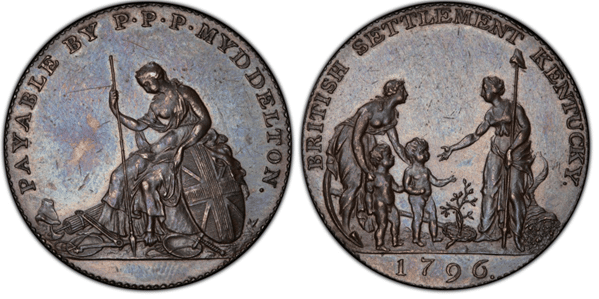
Boulton’s Soho Mint struck about 53 silver pieces in March 1796, with early deliveries reported around 8 March 1796. However, Myddleton’s arrest turned a planned community currency into a reputational risk. Boulton, seeing the complications, did not proceed as if the tokens were a normal commissioned issue. After the conviction, Boulton likely felt the tokens were a danger to his reputation. They were held back or returned to the Soho Mint. A very small number of copper examples were also struck with the same design but there are no records of how many were struck or distributed.
Because the pieces never circulated, they remain scarce, often lightly worn, and the subject of ongoing research. They were created for a practical purpose, but that purpose never reached day-to-day circulation.
Symbolism, Metals, and Survivors
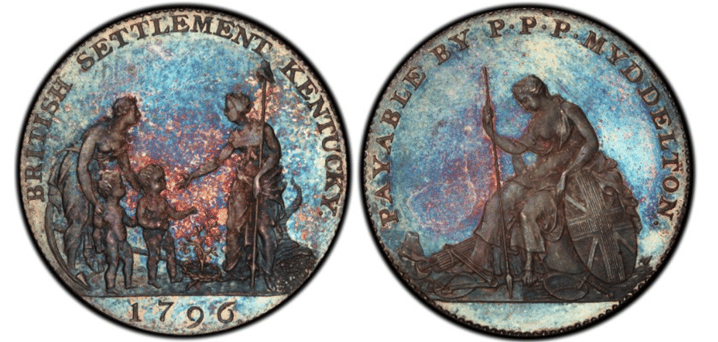
Collectors also note the detailed artwork on the tokens. The obverse presents a hopeful tableau. Miss Liberty holds a staff topped by a Liberty Cap, greeting an allegorical figure of Hope, who presents two children to Liberty. The obverse shows Hope presenting two children to Liberty, a symbolic pitch often read as encouraging emigration and settlement in the proposed Kentucky community. Additional symbols reinforce the promotional message: a cornucopia behind Liberty is commonly read as representing abundance, and Hope is shown with an anchor, a motif often interpreted as constancy and/or an emigrant voyage theme.
The reverse presents a contrasting scene: Britannia seated with her head lowered, weeping. She holds a spear inverted, point down, a traditional symbol of defeat or mourning. At Britannia’s feet lie symbols of liberty and governance, commonly described as the Liberty cap, scales of justice, and fasces, cast into disarray. The juxtaposition is deliberate: the old world is sorrowful and diminished; the new community is framed as free, fertile, and forward-looking.
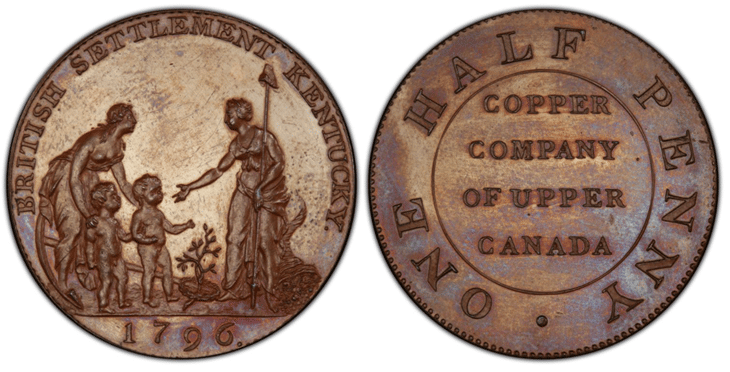
Because no comprehensive records were kept, many basic questions remain unresolved. We do not know the full copper mintage, how many copper pieces survived, or why the Myddleton obverse was later paired as a mule with a token from the Copper Company of Upper Canada. The mule pieces (Myddleton obverse paired with a Copper Company of Upper Canada reverse) typically show minimal wear, and some references suggest they may have been made for numismatic purposes or as coiner’s samples, rather than for everyday commerce. Across silver, copper, and mule varieties, sources suggest perhaps a couple dozen total examples, while others describe several dozen known, underscoring how limited and uncertain the surviving population is.