
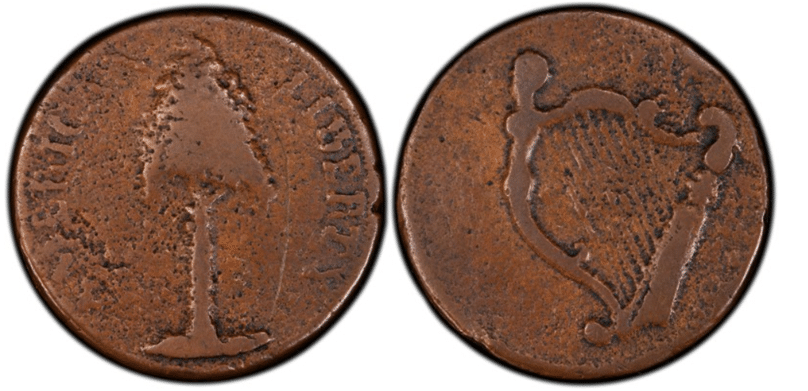
Origins and Rarity of New Hampshire’s Authorized Copper Coin of 1776
In 1776, the year the American colonies moved from resistance to revolution, New Hampshire took an notable step for a colony with no established minting infrastructure by briefly pursuing locally made copper coinage. Like its neighbors across New England, the colony had long relied on a patchwork of circulating money, with British copper halfpennies and other imported pieces appearing frequently in everyday trade. In that environment, New Hampshire became one of the earliest states to consider striking its own copper coins, intending to produce a local substitute that would be familiar in size and weight, yet distinctly American in message.
Why New Hampshire Moved Toward a State Copper
On March 13, 1776, a joint committee of the New Hampshire legislature examined the possibility of producing copper coinage. The motive was economic convenience as well as political identity. British coinage was still plentiful in New England, but the growing desire to separate daily commerce from royal authority gave the idea of locally produced coins real momentum.
The legislature chose a practical path. Rather than reinvent the dimensions of small change, the proposed New Hampshire copper would be comparable in size and weight to the British halfpenny coppers already familiar to merchants and consumers. Matching familiar size and weight made circulation more likely. At the same time, the devices and legends would be determined by New Hampshire’s own General Assembly, ensuring that even a small copper coin could function as a statement of allegiance and independence.
The Moulton Design and the June 28 Authorization
To execute the work, New Hampshire turned to silversmith William Moulton (III) of Hampstead, who produced the copper patterns associated with the 1776 proposal. Moulton was selected to design and create the state’s first coinage, translating legislative intent into a workable piece of struck copper.
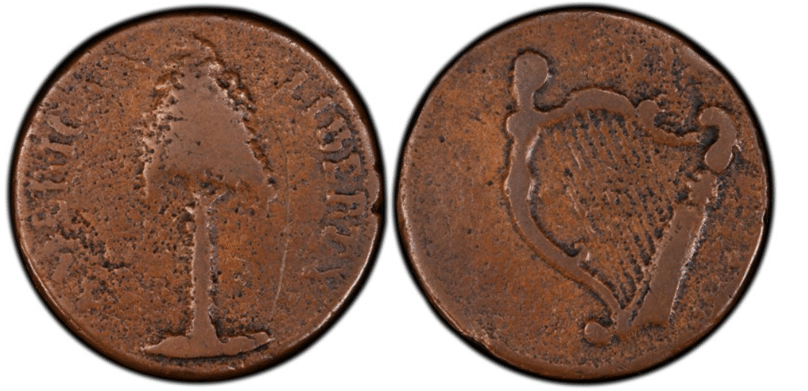
The General Assembly passed the authorizing law on June 28, 1776, six days before the Declaration of Independence. The General Assembly specified a straightforward, emblematic design. The obverse was to display a pine tree, paired with the legend “AMERICAN LIBERTY”. The pine tree carried deep regional meaning in New England and visually connected the coin to local identity. The reverse was to bear a harp and the date “1776”, anchoring the piece to its moment in history.
Although later years produced additional “New Hampshire copper” varieties in numismatic conversation, those pieces have been exposed as 1850s fantasy issues rather than genuine colonial-era coinage. Modern scholarship emphasizes that only the pine tree and harp design is supported by surviving legislative acts and is therefore the authentic, authorized New Hampshire type.
Patterns, Rarity, and What Survives Today
Despite the legislative approval, the true 1776 New Hampshire copper is very scarce. The surviving examples are best understood as pattern strikings, coins produced to demonstrate the proposed design and secure final acceptance, rather than mass coinage made for broad commerce. Survival is limited, with the number of known genuine specimens commonly cited as 3 to 9.
Surviving pieces vary in condition; at least one example is certified VF-25 and described in auction literature as likely the finest known. At least one specimen is held by the Smithsonian’s National Numismatic Collection, and another is reported in the American Numismatic Society. Other examples have appeared in major private collections and at auction (including a Stack’s Bowers sale in March 2012), though the exact total known remains debated. Taken together, these coins represent more than a proposed monetary fix; they show New Hampshire’s local initiative at the precise moment the colonies were redefining what authority, identity, and independence would look like in everyday life.