
Among the private, locally made pieces that collectors often group with early American and “colonial” issues, few are as debated as the 1790 Standish Barry Three Pence. It is a small silver coin tied to Baltimore, Maryland, and a known craftsman. Yet several key details remain unsettled. We can identify who made it, describe exactly what it says and shows, and estimate how rare it is. What we cannot state with certainty is why it was struck, what event it may commemorate, or even whose portrait appears on the obverse.
Standish Barry, documented in Baltimore as a watch/clockmaker, engraver, and later silversmith, is widely credited with producing the three pence, and the coin’s reverse legend naming him is a key reason the attribution is so strong. Unlike many contemporary tokens and coppers that have anonymous origins, the Barry Three Pence names its maker directly, an unusual feature for the era. It is a tangible intersection of early American commerce, local pride, and the practical skills of an artisan working before the nation’s coinage system had fully stabilized.
The Standish Barry Three Pence Design
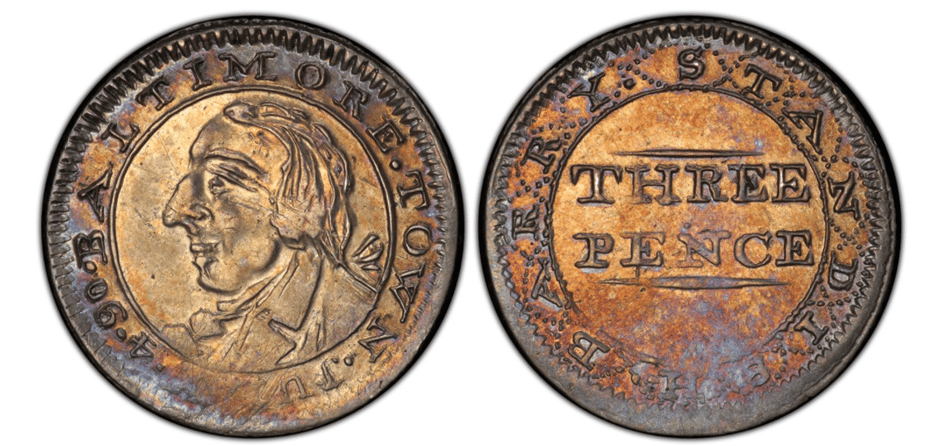
The Standish Barry Three Pence is simple, direct, and text-forward, which fits a locally produced piece meant to be understood quickly. The obverse features a left-facing bust of a man, surrounded by the legend “BALTIMORE • TOWN • JULY • 4 • 90 •”.
The reverse presents the denomination clearly, with “THREE PENCE” on two lines within an inner border. Around that central inscription is the maker’s name, “STANDISH BARRY”.
Those design choices do two things at once. They anchor the coin to Baltimore Town and to the date July 4. They also advertise the maker in a way that feels almost like a calling card, a hallmark in coin form. With its clear denomination and issuer name, the piece could circulate like a coin in local trade, even if its original purpose may have included advertising or commemoration as much as day-to-day money.
The Portrait and the Date Mystery
The obverse bust is the coin’s most debated feature. Early speculation suggested the image might be a crude representation of George Washington, which would match the patriotic flavor implied by a July 4 inscription. Another idea proposed that Barry placed himself on the coin, since his name appears prominently on the reverse.
Recent scholarship favors James Calhoun, a Baltimore political figure who became the city’s first mayor in the late 1790s. Contemporary and later references have been cited as pointing in that direction. Even so, the portrait remains “accepted” rather than definitively proven, which keeps the coin’s story open to interpretation.
The date inscription raises its own set of questions. “JULY • 4 • 90 •” is usually read as July 4, 1790, but researchers have not identified clear contemporary documentation tying the token to a specific 1790 Baltimore event. A documented July 4, 1809, procession involving Baltimore silversmiths has inspired alternative theories (including a ‘09/90’ date mix-up), but most researchers view an 1809 issue date unlikely.
Rarity, Survivorship, and Collecting
However it is interpreted, the Standish Barry Three Pence is rare. The exact number struck is unknown, but it was clearly a small production, given how few examples are known today (15-20 known examples). Most survivors show clear wear, suggesting use or handling over time, though a small number of higher-grade specimens are known.
Many examples also show die deterioration, early breaks, and off-center strikes, suggesting hurried production. For collectors, that combination of low survivorship, variable striking quality, and historical ambiguity makes a genuine example difficult to obtain and interesting to study.