
Late 18th-century America had a persistent problem: not enough small change. Even after the United States Mint opened in Philadelphia and began striking cents and half cents, everyday commerce still relied on a patchwork of foreign coins, privately issued tokens, and local substitutes. Into that environment came one of the most notable large-format pieces of the era, the Theatre at New York token, an undated piece generally attributed to the late 1790s (often cited as circa 1796–1797).
The Theatre at New York token is notable for its size and ambitious design. At roughly 34-35 mm in diameter, it is larger than most tokens intended to pass as low-value change. Unlike many tokens of uncertain origin, its engraver and producer are documented. The dies are attributed to Benjamin Jacob of Birmingham, England, a known die sinker, and the pieces are generally attributed to Peter Skidmore of London, struck at his metalworks.
The token touches two themes that mattered to the young republic: cultural identity and commercial growth. Its imagery celebrates both, while its edge inscription makes a clear claim to monetary utility.
Design and Messaging
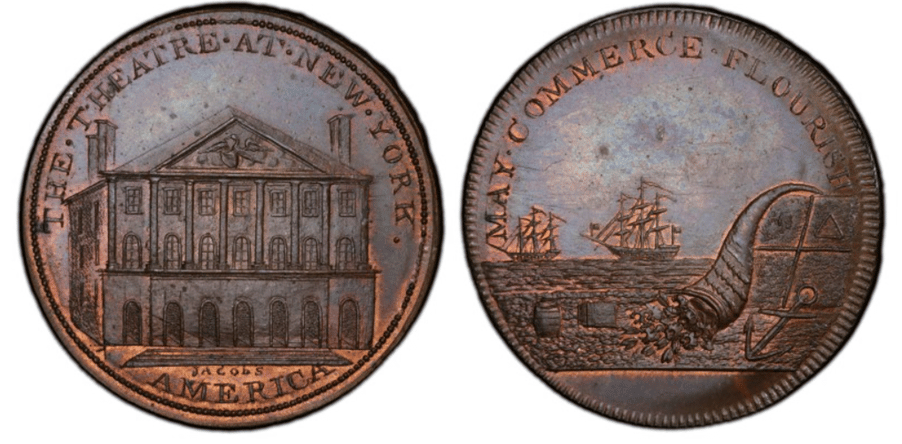
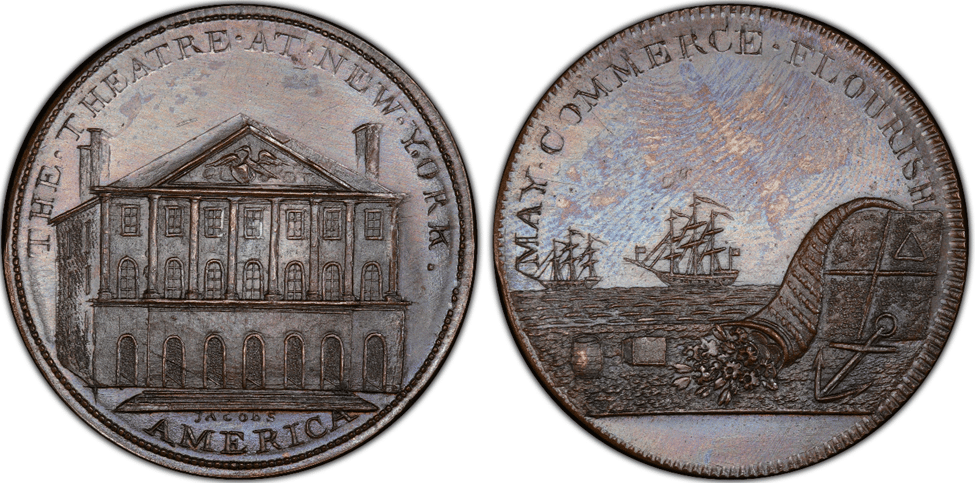
The obverse presents the façade of a prominent New York theater and carries the legend “THE . THEATRE . AT . NEW . YORK .” with “AMERICA” at the bottom. Beneath the steps appears the engraver’s signature, “JACOBS,” a detail that helps anchor attribution. A further technical curiosity is that the lettering was hand-cut rather than formed with punch letters, a slower and more demanding method that can give the legends a slightly different visual character than many contemporary tokens.
Although commonly cataloged as 1797, the undated token likely depicts the First Park Theatre as it appeared when it opened in 1798. That mismatch adds to the token’s interest. It suggests the piece was forward-looking or promotional in spirit, tying New York’s rise as a cultural center to the expanding commercial identity of the United States. Whether meant as a celebration of a major civic project, a speculative bid for business, or both, the token’s design clearly aims higher than a routine trade ticket.
The reverse reinforces the commercial message. It shows two ships under full sail and an arrangement of goods and symbols in the foreground: a barrel, package, cornucopia, anchor, and a bale of cotton. The legend “MAY . COMMERCE . FLOURISH .” states the message plainly. It is a motto for a port city and a trading economy, presented in the visual language of maritime power, agricultural plenty, and dependable exchange. Most direct of all is the edge inscription: “I PROMISE TO PAY ON DEMAND THE BEARER ONE PENNY X.” That wording echoes the logic of private money, offering a stated redemption value and implying a guarantee behind the piece. In practice, such promises depended on trust, local acceptance, and the issuer’s reputation..
Why It Matters to Collectors
Skidmore is often described as having produced the token “on speculation,” apparently hoping it would help him secure a commission for additional token work. That strategy made sense in a period when small change remained scarce and private makers believed profitable demand still existed. Yet the federal government’s assumption of coin production beginning in 1793 narrowed the opportunity for large private token contracts, and the hoped-for commissions did not materialize.
The small number of known examples underscores its limited output. Survivorship is small, often summarized as around a dozen proof examples, with overall known populations sometimes cited at roughly ~20 pieces, depending on how specimens are classified. Today, the token is valued not only as a scarcity but as a compact historical document: it captures New York’s aspirations, the era’s dependence on private exchange, and the persistent link between commerce and civic life in the early republic.