
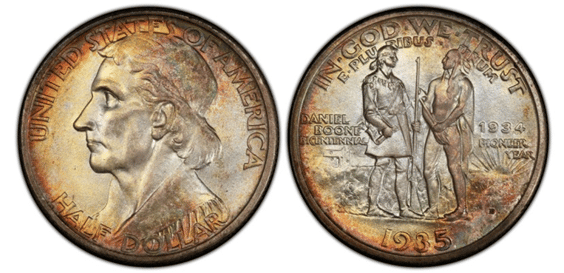
Honoring Daniel Boone’s Birthday
The Kentucky Daniel Boone Bicentennial Commission proposed a commemorative half dollar to mark the 200th anniversary of the frontiersman’s birth on November 2, 1734. Boone remains an iconic American hero, having served in the French and Indian War. He was a farmer, trapper, huntsman, trader, explorer, businessman, and politician. During the early days of westward expansion, Boone’s explorations helped open the frontier to new settlements for the United States, like Kentucky, Ohio, and Missouri.
Rebecca Bryan Boone married Daniel Boone on August 14, 1756. They remained married for 56 years until Rebecca’s death, and they raised nine children: five sons and four daughters. William, their tenth child, unfortunately passed away within the year he was born. They lived in what is now North Carolina, Virginia, Kentucky, and then settled in Spanish Upper Louisiana (present-day Missouri). Daniel and Rebecca Boone spent the last years of their life there. Daniel Boone passed away on September 26, 1820, at the home of his son, Nathan Boone, in Defiance, Missouri. He was laid to rest beside his wife.
Design of the Daniel Boone Bicentennial Half Dollar
The coin received Congressional approval and was signed into law by President Franklin D. Roosevelt. The commission hired Henry Augustus Lukeman to create numerous sketches for the proposed coin design. Lukeman was best known for taking over the design phase of the Stone Mountain project after Gutzon Borglum was fired.
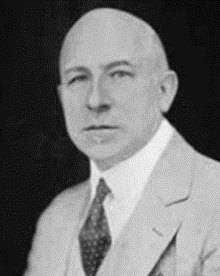
Lukeman designed the obverse of the coin to have a portrait of Boone, facing left, in frontiersman’s buckskins. Above his head is “UNITED STATES OF AMERICA”, and below his portrait is the denomination “HALF DOLLAR.” The reverse has a full-length portrait of Boone meeting with “Blackfish”, the War Chief of the Chillicothe band of the Shawnee tribe. Above them are “IN GOD WE TRUST” and “E PLURIBUS UNUM” under that. To the right is “1934 PIONEER YEAR”, and to the left is “DANIEL BOONE BICENTENNIAL”. At the bottom is the year in which the coins were struck.
Distribution Details
The coins cost the Commission $.50 each and were sold for $1.00 each. The profits were split between the Daniel Boone Bicentennial Commission and the Pioneer National Monument Association.
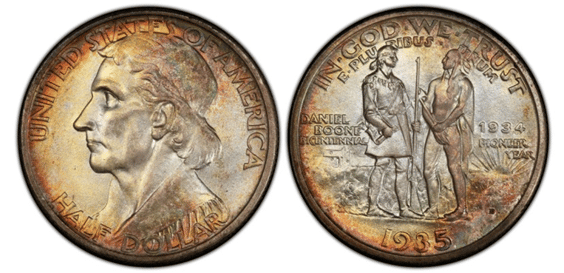
In 1934, 10,007 coins were struck at Philadelphia. Beginning in 1935, the coins were reissued and struck at all three mints, and the mintage date “1934” remained on the reverse for all coins. Following criticism from collectors and Treasury officials, the “1934 PIONEER YEAR” inscription was removed from later 1935 issues. In 1935, with 1934-dated coins, 10,008 coins were struck in Philadelphia, and 2,003 and 2,004, respectively, at the Denver and San Francisco mints.
Later in 1935, the 1934 date was removed from the reverse, and 10,010 coins were struck at Philadelphia and 5,005 each at Denver and San Francisco. In 1936, 1937, and 1938, coins were struck at all three mints, but mintages declined significantly due to weak sales.
Add these coins to your collection, along with other U.S. classic silver commemorative coins.