
Learn About the 1925 Diamond Jubilee of California
The 1925 Diamond Jubilee marked the 75th anniversary of California’s admission to the Union (1850–1925). As the Jubilee celebrations approached, the San Francisco Citizens’ Committee sought a commemorative half dollar to help defray the cost of the celebration.
San Francisco’s Diamond Jubilee opened on Saturday, September 5, 1925, with an automobile parade along Market Street featuring noted race-car driver Barney Oldfield. Later on opening day, officials designated a section of the Embarcadero as the “Joy Zone,” offering games, circus acts, bands, bathing-beauty revues, and water exhibitions with speedboats, fireboats, seaplanes, and fishing craft. The celebration’s focal point was the “Arco de Brillantes,” a large jewel-encrusted archway in Civic Center Plaza.
Vice President Charles G. Dawes was there and led the Admission Day parade. An estimated 650,000 spectators lined the parade route to watch floats and marching units depicting various eras of California history. A few original “forty-niners” were in the Admission Day parade as well. There were different events held through the day and night, and the last day of festivities was on Saturday, September 12, 1925.
Coin Details
Joseph designed the obverse and the reverse. While the Commission of Fine Arts disliked his work, the San Francisco Citizens’ Committee did, and the design remained unchanged.
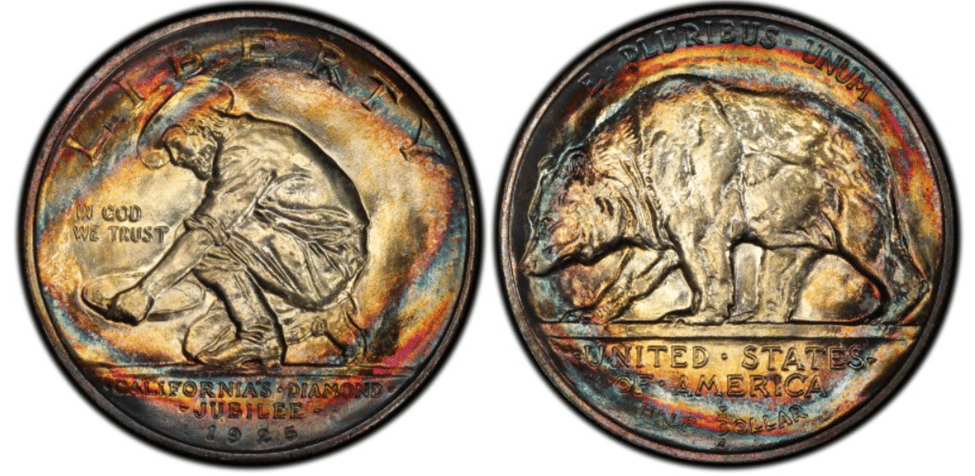
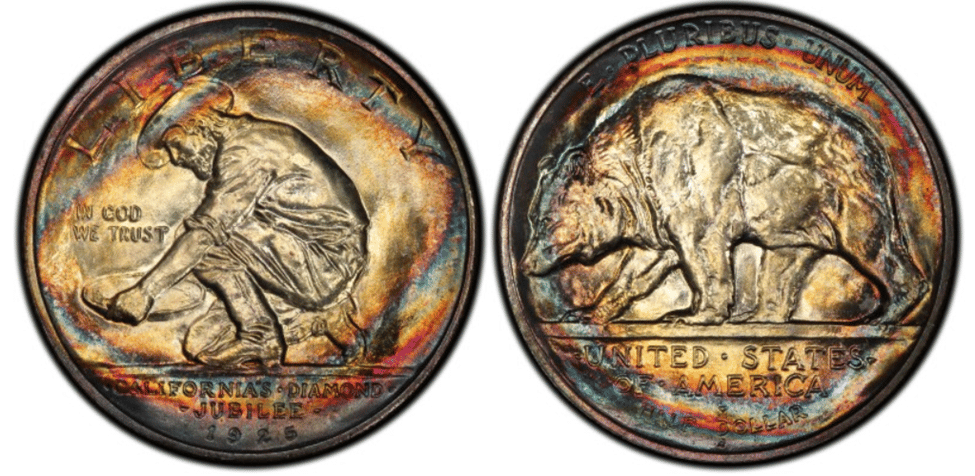
On the obverse, a Gold Rush “forty-niner” era prospector is on one knee, facing left, panning for gold. Above him on the top periphery is ”LIBERTY”, and below him in three lines are “CALIFORNIA DIAMOND – JUBILEE – 1925.” The Motto “IN GOD WE TRUST” appears to the left of him. The reverse depicts a California Grizzly Bear, walking to the left, with “E PLURIBUS UNUM” at the top periphery and in three lines below him, “UNITED STATES – OF AMERICA – HALF DOLLAR.”
Minting and Distribution Details
The 1925 California Diamond Jubilee Silver Half Dollars were struck in August 1925 at the San Francisco Mint. Over 150,000 coins were struck, and only about 86,000 were officially distributed. The rest were returned for melting, and the remaining total of the 300,000 authorized coins were never struck. The coins were distributed by the San Francisco Clearing House Association and the Los Angeles Clearing House Association.
The first 1925 California Diamond Jubilee Silver Half Dollar that was struck was presented to the Memorial Museum in Golden Gate Park in San Francisco. A specially polished die was used for the initial strikes, producing a frosted or cameo effect. Coins displaying that effectively bring a premium in the marketplace.
California children born on the 75th anniversary of California statehood (September 9, 1925,) were given one of the half dollars, totaling 494 coins matching the recorded births. A few pieces were mounted in badges used by officials of the celebration, and those badges are considered scarce today. Many of the remaining coins were sold at the primary celebration in San Francisco from September 6-12.
To find more commemoratives similar to this coin, check out APMEX’s collection of U.S. classic silver commemorative coins.