
History of the Huguenots and Walloons
In 1924, the 300th anniversary of the French Huguenots’ and Belgian Walloons’ arrival in the New York area approached. To mark the occasion, the Federal Council of Churches proposed a commemorative coin and guided the bill through Congress. The bill sailed through Congress without opposition and was signed by President Harding, who also had his own presidential dollar.
French Huguenots were French Protestants who fled to England, Germany, the Netherlands, and the American colonies to escape religious persecution. Today, they are referred to as French Protestants, members of the Reformed Church (Église Réformée), or simply by their national/denominational affiliations in their new homes. Existing surnames like Du Toit, Malan, or De Villiers are directly related or tied to these immigrants.
Belgian Walloons were French-speaking people from the Wallonia region of what is now Belgium. The Walloons were also protestants fleeing Catholic Spanish religious persecution, and about 30 families came to New York. They arrived in 1624 on a ship chartered by the Dutch West India Company. The Walloons joined the Dutch settlers to colonize Manhattan and the Hudson River Valley, establishing the first European families in the area, and moved out to New Jersey, Connecticut, and Rhode Island.
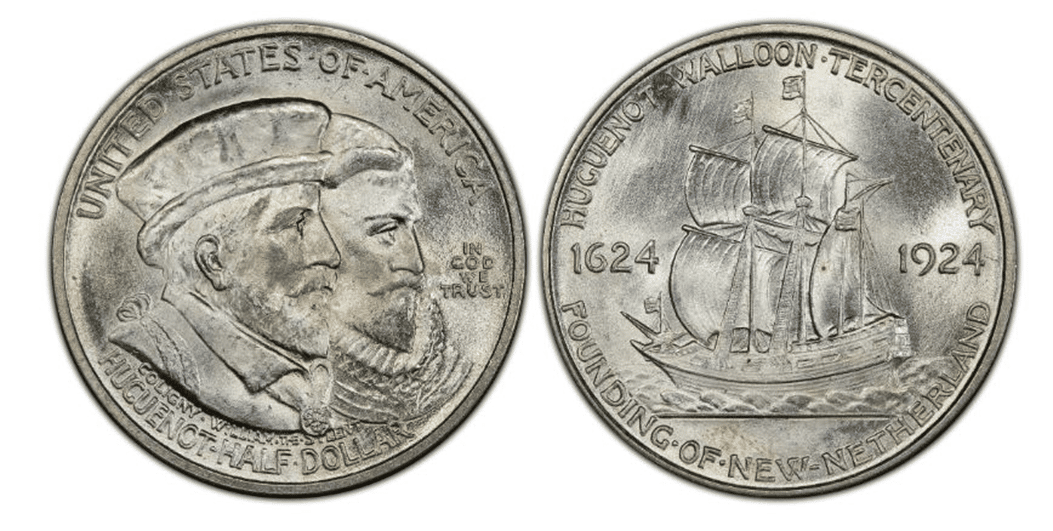
The coin honors the 1624 landing of Huguenots and Walloons. Admiral Gaspar de Coligny was one of the Huguenots’ political and military leaders during the French Wars of Religion. William the Silent was a leader of the Walloons and was assassinated by Balthasar Gérard. Their busts were chosen for this commemorative coin. Even though neither man had anything to do with the landing of Huguenots or Walloons in 1624, both were influential to these groups of people and were considered heroes.
Design Details
The US Mint’s Chief Engraver, George T Morgan, designed conjoined busts of de Coligny and William the Silent for the obverse. Surrounding them are “UNITED STATES OF AMERICA” at the top periphery, their names underneath the busts, “IN GOD WE TRUST” to the right, and “HUGUENOT * HALF * DOLLAR” on the lower periphery.
The reverse depicts the vessel that brought the Huguenots and Walloons to the New World, the “Nieuw Nederland.” Above the ship on the top periphery is “HUGUENOT * WALLOON * TERCENTENARY” then the dates “1624 1924” and the bottom periphery of the coin bears the legend “FOUNDING * OF * NEW * NETHERLAND”. Between February and April 1924, the Philadelphia Mint struck 142,080 Huguenot-Walloon Half Dollars. They were sold for $1 each through the Fifth National Bank and other outlets.
Secondary Silver
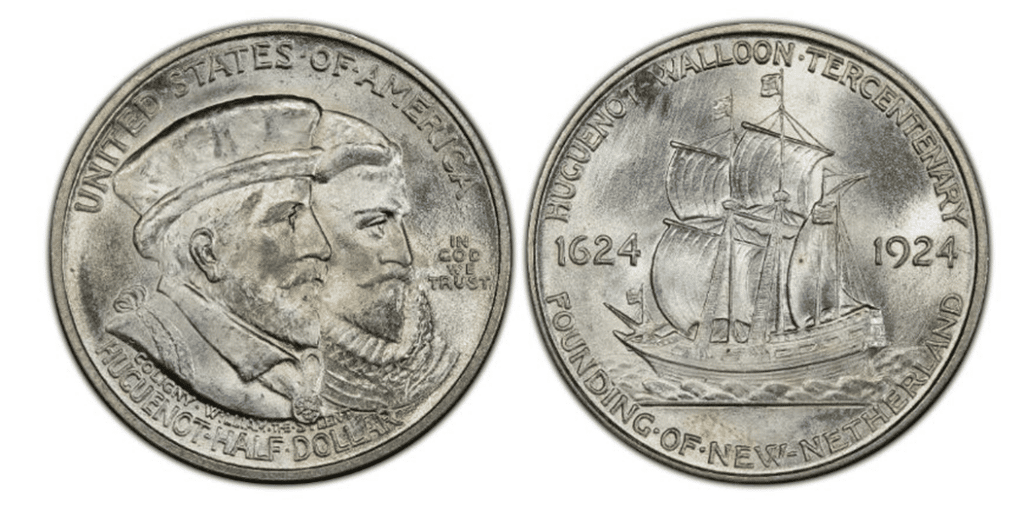
Today, collectors can still find these U.S. classic silver Huguenot-Walloon Tercentenary Half Dollars on the secondary market. Secondary market silver offers a cost-efficient way to preserve wealth and invest for the future. Whether you’re adding weight to your holdings or making your first substantial investment in precious metals, secondary market silver offers an efficient path to expanding your portfolio and preserving your purchasing power.
For other historic finds, make sure to check out our rare coins & currency selection and expand your collection today with our collection of U.S. classic silver commemorative coins.