
The History of Maryland
The Maryland Tercentenary Commission sought to have a commemorative half dollar issued to mark the 300th Anniversary of the arrival of English settlers in Maryland in 1634. A postage stamp and the 1934 Maryland Tercentenary Half Dollar helped pay for celebration expenses. The bill authorizing 25,000 coins became law with the signature of President Franklin Roosevelt.
Maryland was named for Queen Henrietta Maria, consort of King Charles I. Leonard Calvert, the younger brother of Cecil Calvert, led the first colonists out of Cowes on the Isle of Wight on November 22, 1633. Traveling in two boats, the Ark and the Dove, the party arrived at St. Clement’s Island in southern Maryland on March 25, 1634.
From 1763 to 1767, surveyors Charles Mason and Jeremiah Dixon charted the line that now separates Maryland from Pennsylvania. In 1791, the state contributed a strip of land that helped create the District of Columbia.
In 1814, British forces bombarded Fort McHenry during the attack on Baltimore, inspiring Francis Scott Key to compose “The Star-Spangled Banner.” In the Civil War era, Maryland permitted slavery yet remained within the Union, a stance that split loyalties and even families across the state.
Design Details
The Maryland Tercentenary Commission sought to have a commemorative half dollar issued to mark the 300th Anniversary of the arrival of English settlers in Maryland in 1634. A postage stamp and the 1934 Maryland Tercentenary Half Dollar helped pay for celebration expenses. The bill authorizing 25,000 coins became law with the signature of President Franklin Roosevelt.
The Commission had Hans Schuler of the Maryland Institute College of Art prepare a design that, after some suggestions and criticisms, moved forward and was approved. Changes were made, and John R. Sinnock, the US Mint’s Chief Engraver, created the models, and the design received approval.
The obverse design displays a bust of Cecil Calvert, also known as Lord Baltimore, facing right, with “UNITED STATES OF AMERICA” across the top periphery. To the right of his bust is “IN GOD WE TRUST,” and to the left is “E PLURIBUS UNUM.” Below the bust is “CECIL CALVERT,” and the denomination, “HALF DOLLAR,” is at the bottom periphery.
The reverse design is the Coat of Arms of the State of Maryland, with “MARYLAND TERCENTENARY 1634 – 1934” around the periphery. One figure represents Labor, and the other represents Fisheries. The state motto, “FATTI MASCHII PAROLE FEMINE,” is found on a ribbon beneath the arms. Translated, the motto says “Deeds are manly, words are womanly.” “MARYLAND TERCENTENARY” is located at the top of the coin.
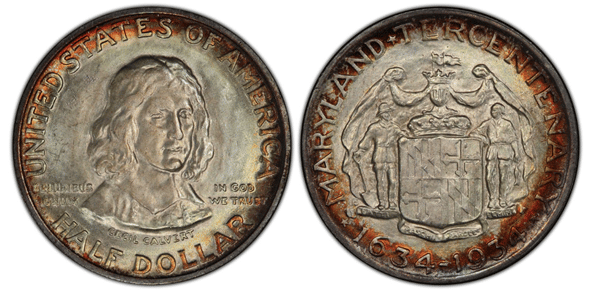
25,000 coins were authorized and struck, and all were eventually sold, some at a discount after the celebration ended. The coins were initially sold at $1.00.
Lyman Hoffecker, who would be responsible for the Elgin and Old Spanish Trail commemorative coins the following year, inquired about purchasing a large quantity of Maryland half dollars, only to be advised that the supply had been exhausted.
In March of 1936, Hoffecker testified before Congress about abuses in commemorative coin issuances (both of which he was associated with were problematic). He stated that 1,000 Maryland coins had been sold to one dealer and that Maryland Tercentenary employees had purchased hundreds of the coins. Expand your collection today with this historic coin and view our collection of U.S. classic silver commemorative coins.