
Commemorating the 1992 Olympic Games
In 1992, the Olympic Summer Games were held in Barcelona, Spain, and the Albertville Winter Games were staged in Albertville and Savoie, France. To commemorate the winter and summer Olympic Games and to raise money for American Olympic athletes, Congress authorized the minting of a commemorative clad half dollar, a silver dollar, and a five-dollar gold coin.
1992 Olympic Commemorative Clad Half Dollar
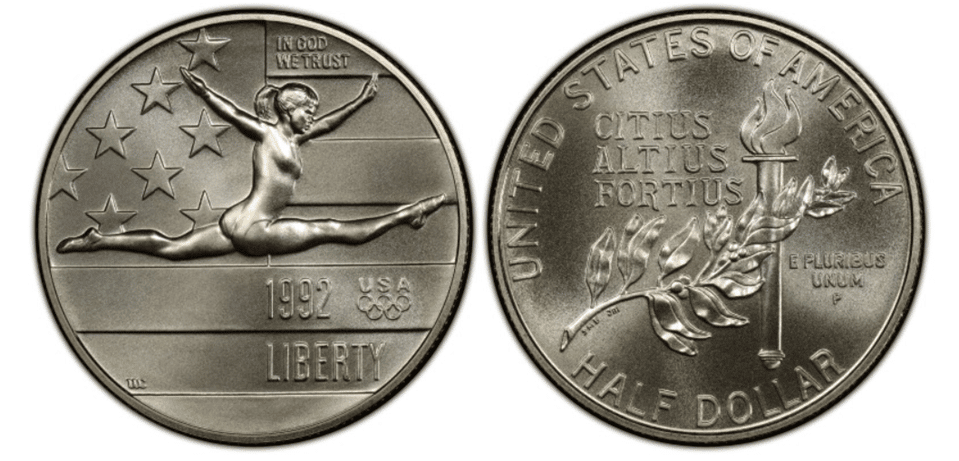
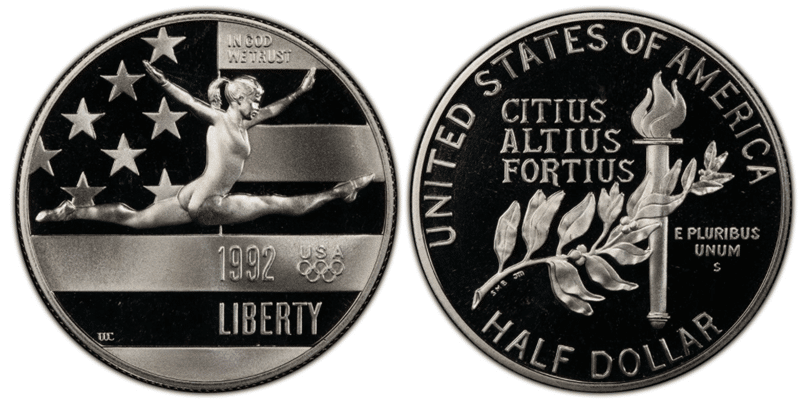
The obverse of the half dollar was designed by William C. Cousins and depicts an Olympic female gymnast in motion with a large American flag filling the entire design. You can see some of the stars and stripes, and above her is “IN GOD WE TRUST” and below her are the five Olympic rings, the date “1992”, and the word “LIBERTY”.
The reverse depicts an Olympic torch with an olive branch representing peace. “E PLURIBUS UNUM” is to the right, and around the peripheries are “UNITED STATES OF AMERICA” and “HALF DOLLAR” on the upper and lower periphery, respectively. To the left of the torch is the Latin inscription, “CITIUS, ALTIUS, FORTIUS,” which is the Olympic motto: (Faster, Higher, Stronger). The reverse was designed by Steven M. Bieda and sculpted by John Mercanti.
The uncirculated coins were struck at the Philadelphia Mint and have a “P” mintmark, while the proof coins were struck at the San Francisco Mint and have an “S” mintmark. While 6,000,000 were officially authorized, less than 700,000 of the uncirculated and proof coins were sold.
1992 Olympic Commemorative Silver Dollar
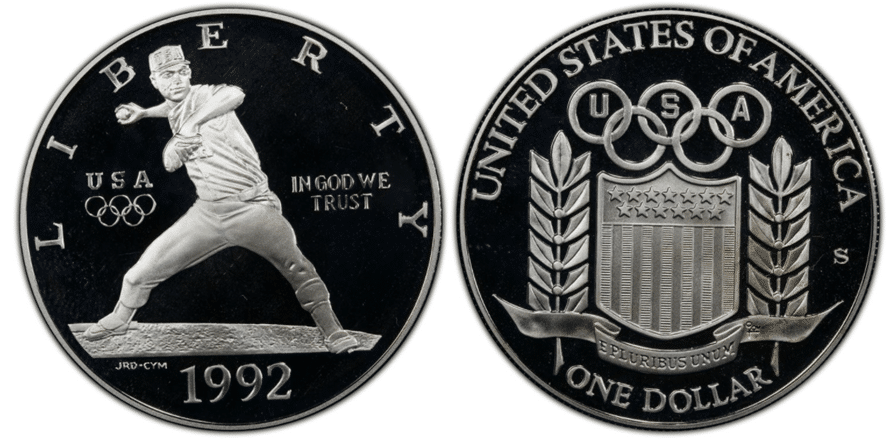
The next coin to be struck was the 1992 Olympic Commemorative Silver Dollar, minted in uncirculated and proof. The obverse of the coin depicted an Olympic baseball pitcher rearing back to throw a pitch to the plate. In front of the pitcher is the motto “IN GOD WE TRUST,” and behind him are the five Olympic rings and the letters “USA” above the rings. The upper periphery has the word “LIBERTY” while the lower periphery has a large-sized date “1992”. The obverse was designed by John R. Deecken and sculpted by Chester Y. Martin.
The reverse was designed by Marcel Jovine. The reverse has an American shield with stars and stripes in the center. There is a large olive branch on either side of the shield and a banner below, on which is inscribed “E PLURIBUS UNUM.” The five Olympic rings are above the shield, and the letters “USA” appear in one of the three top Olympic rings. The upper periphery has “UNITED STATES OF AMERICA” and the lower periphery has the denomination “ONE DOLLAR”.
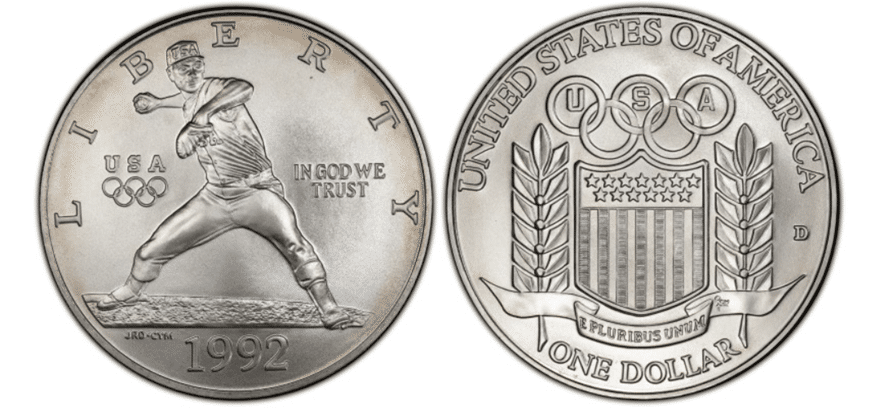
The uncirculated silver dollars were struck at the Denver Mint and have a “D” mintmark, while the proof silver dollars were struck at the San Francisco Mint and bear an “S” mintmark. Although 4,000,000 coins were authorized by Congress, fewer than 700,000 uncirculated and proof coins were struck. Additionally, for the very first time, edge lettering appeared on a U.S. commemorative coin. Written around the edge four times is “XXV OLYMPIAD”. This edge lettering appears only on the silver dollar.
1992 Olympic Commemorative Gold $5 Coin
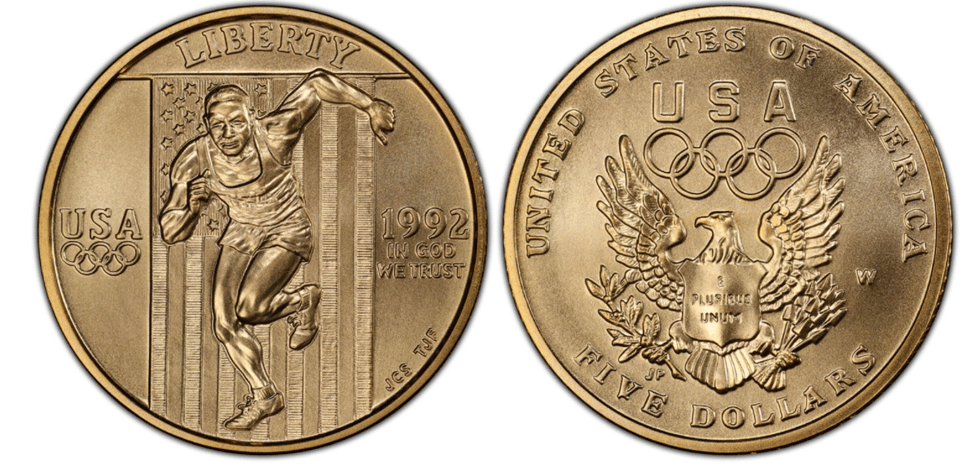
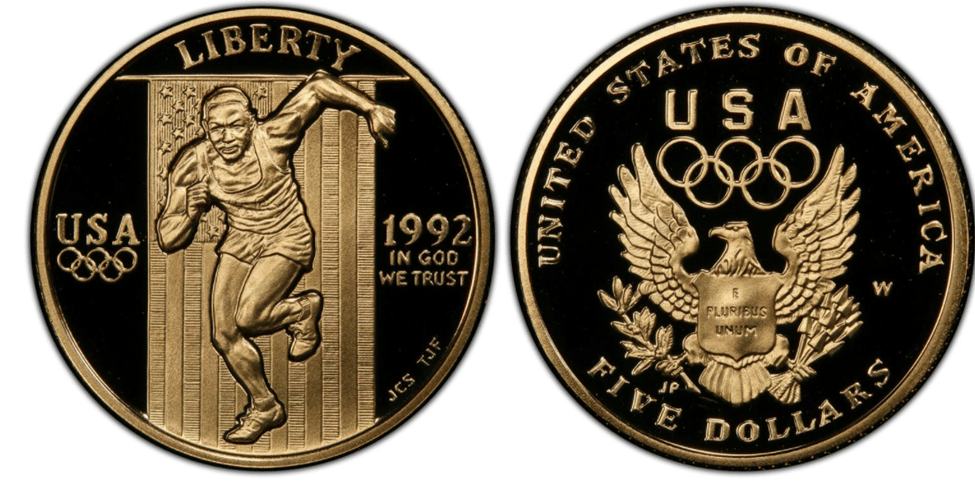
The final coin to be authorized was the gold coin. The obverse of the coin shows an Olympic sprinter running. Superimposed behind the sprinter is an American flag, hanging vertically. Above the sprinter at the top periphery is the word “LIBERTY”, to the right is the date “1992”, and the phrase “IN GOD WE TRUST”, and to the left are the five Olympic rings and the letters “USA” above them. This obverse was designed by James Sharpe and sculpted by Thomas J. Ferrell.
The reverse features a heraldic-style eagle with its wings spread, which almost looks like it is holding the five Olympic rings and the letters “USA” balanced between the wings. The eagle has a shield covering its breast, and the shield is inscribed with “E PLURIBUS UNUM.” The upper periphery has “UNITED STATES OF AMERICA,” and the lower periphery has the denomination “FIVE DOLLARS.” James Peed created this reverse design.
Uncirculated and proof gold coins were struck at the West Point Mint, and both carry the “W” mintmark. Although Congress authorized 500,000 coins, slightly over 100,000 uncirculated and proof coins were sold.
Add these coins to your collection today and shop other U.S. classic silver commemorative coins and modern U.S. gold commemorative coins.