

Celebrating 300 Years of York County, Maine
York County, Maine, originated in 1636 as a colonial administrative county under the authority of Sir Ferdinando Gorges and is recognized as one of the earliest county-level jurisdictions in what is now the United States. Sir Ferdinando Gorges, an English colonist and entrepreneur, held land patents beginning in 1622 for what became known as the Province of Maine. Through his leadership and that of his associates, including Richard Vines, some of New England’s earliest enduring European settlements developed in York, Kittery, and Saco during the early seventeenth century, despite periods of disruption and conflict.
The tercentenary of the founding of York County, Maine, was approaching in 1936, so members of Congress from Maine lobbied their colleagues for a commemorative half-dollar that could be sold at a profit to help defray expenses. The bill authorized the striking of 30,000 1936 York County, Maine Tercentenary Half Dollars. The York County Tercentenary Commemorative Half Dollar Committee was in charge of distribution.
Design Details
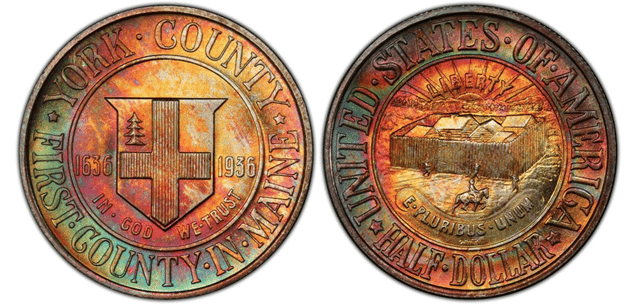
Walter H. Rich was chosen to design the 1936 York County, Maine Tercentenary Half Dollar. The reverse of the coin is an adaptation of the Seal of York County, Maine, depicting the shield with a cross in the center and a pine tree in the upper left quadrant. The dates “1636” and “1936” flank the shield. Below the shield is ”IN GOD WE TRUST,” and around the periphery is “YORK COUNTY * FIRST COUNTY IN MAINE”.
The obverse depicts John Brown’s Garrison in Saco, Maine, and there is a rider on horseback and a soldier in view. John Brown’s Garrison in York County, Maine, is a historic site located in what is now Saco, at the corner of Water and Main Streets. John Brown’s Garrison was built around 1720 to protect early settlers. The garrison is a piece of York County’s colonial-era local history. Above the fort is a rising sun with its rays behind the word “LIBERTY.” Beneath the rider is “E PLURIBUS UNUM.” Around the periphery are the words “UNITED STATES OF AMERICA” and “HALF DOLLAR.”
The sculpting of the coin’s design into metal was done by G. S. Pacetti Company of Boston, and the U.S. Mint reduced the dies to coin size.
Mintage & Distribution Details
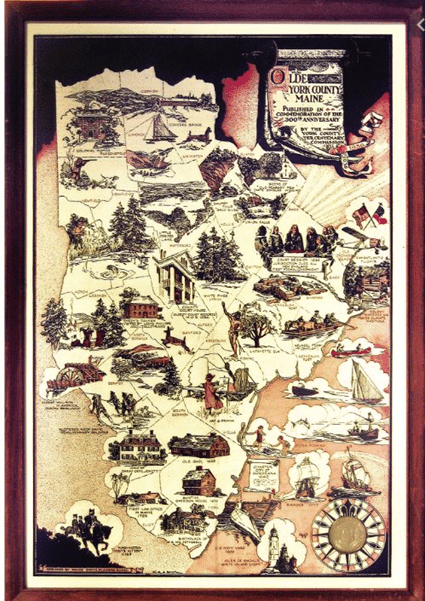
Although the approved legislation called for the minting of 30,000 coins, the Philadelphia Mint struck only 25,015. The first 100 coins struck were presented to dignitaries in numbered framed maps of York County, Maine. Another 100 coins were also placed on unnumbered maps and sold to the public. 15,000 1936 York County, Maine Tercentenary Half Dollars were reserved for residents of Maine, and the remaining 10,000 were sold by mail; sales were not completed until 1953 due to demand.
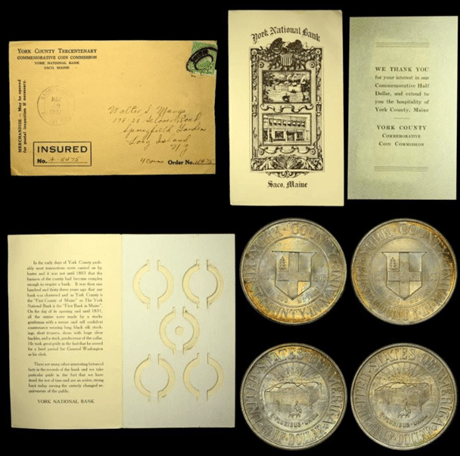
The remaining commemorative coins were originally sold in folding paper holders that featured, on their front cover, black-line drawings of Brown’s Garrison and the York National Bank of Saco. The holders could comfortably and safely hold up to five coins. A tissue paper insert thanked the purchaser for buying these coins. Expand your collection today and shop for other U.S. classic silver commemorative coins.