
The Gold Rush
After gold was discovered in California in 1849, there was a lack of reliable assays and a need for someone to accurately convert gold dust and gold ore into physical coinage. The government later authorized Humbert to serve as the United States Assayer of Gold in California after he had already begun assaying gold privately. In 1851, the official United States Assay Office of Gold was established in California, and one of its most important missions was to strike ingots from the native gold being dug up daily. The ingots were to be between $50.00 and $10,000 in weight and value, and each ingot was to be struck of refined gold of uniform fineness. These ingots were to bear legends and devices that resembled contemporary U.S. coinage.
But the ore from California fields and mountains was not of the highest fineness, so it was easier to stamp the fineness on an ingot than it was to strike a coin from it. The U.S. Mint mandated that all gold coins be struck from .900 Fine gold, while the gold coming out of the ground varied from .850 to .935 Fine. By adding pure gold to the alloy, Humbert achieved ingots with finenesses of 0.880, 0.884, and 0.887. While .900 fine gold was the standard for U.S. gold coinage after the Coinage Act of 1837, the California Assay Office was explicitly permitted to assay gold below this standard due to variability in native gold and the practical constraints of frontier refining.
Humbert offered the miners $16 per ounce of gold they brought in, about twice what the bankers were offering. His pricing and his close arrangement with the U.S. Mint gave him considerable credibility.
Humbert’s 1851 Gold Coins
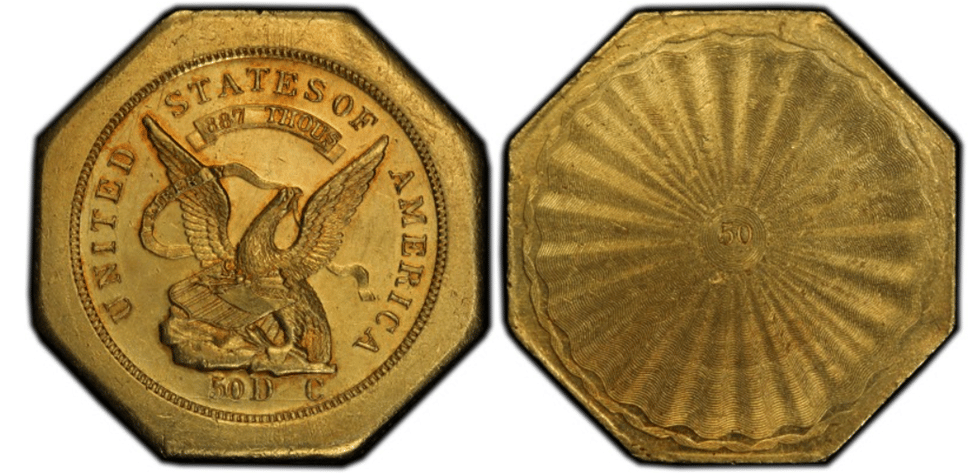
In 1851, Humbert created and struck a $50.00 (face value) gold ingot. This ingot was LARGE (about 2.5 ounces of Gold), octagonal in design, bore a heraldic eagle with upswept wings leaning on a rock, on the obverse, a shield by its breast, the periphery has the legend “UNITED STATES OF AMERICA” and the denomination “50 D.” on it. The reverse features an intricate pattern design, but this coin, shown below, has no text. Around the edge was “AUGUSTUS HIMBERT UNITED STATES ASSAYER OF GOLD, CALIFORNIA 1851” around it.
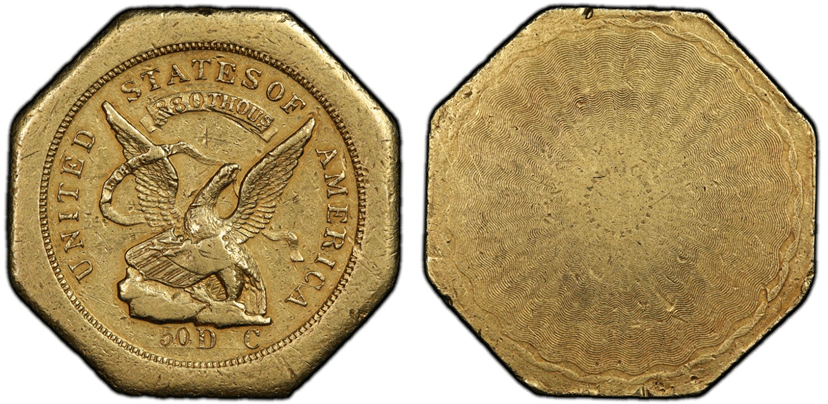
The next ingot produced was identical to the prior one, except that it contained a “50” at the center of the intricate reverse design.
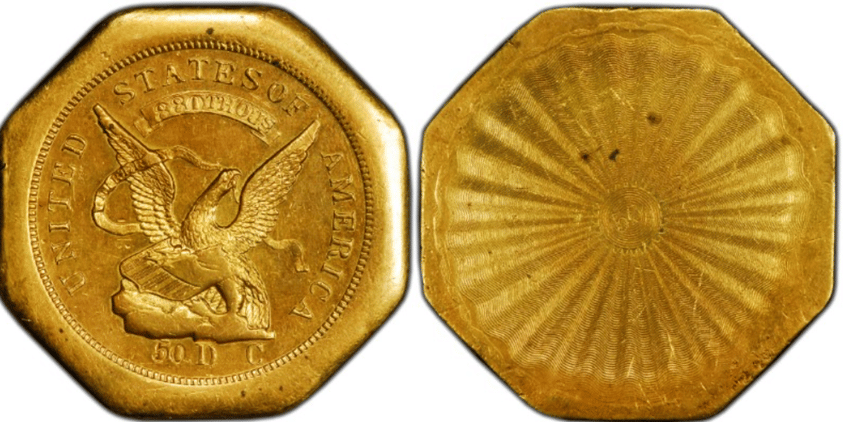
The next ingot was the same as the one above, except that the fineness went from “.880” to “.887”, but all else was the same.
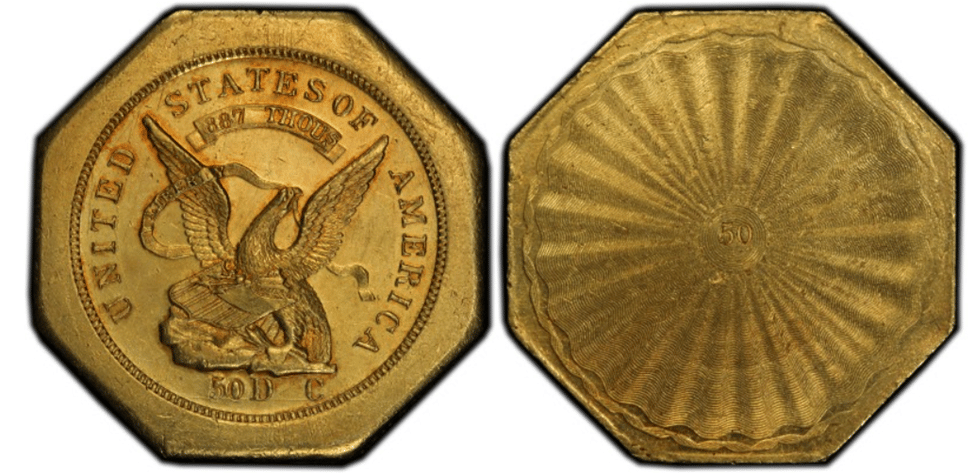
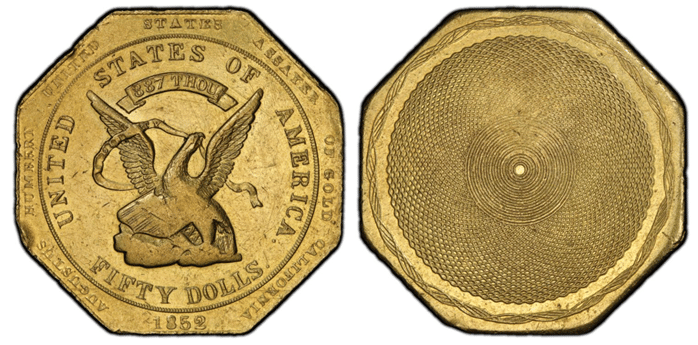
Humbert, over time, replaced the lettered edge with a reeded edge, ostensibly to make it harder to shave off gold from the edge. The “50” was removed from the reverse, so this ingot is often referred to as the “target” reverse.
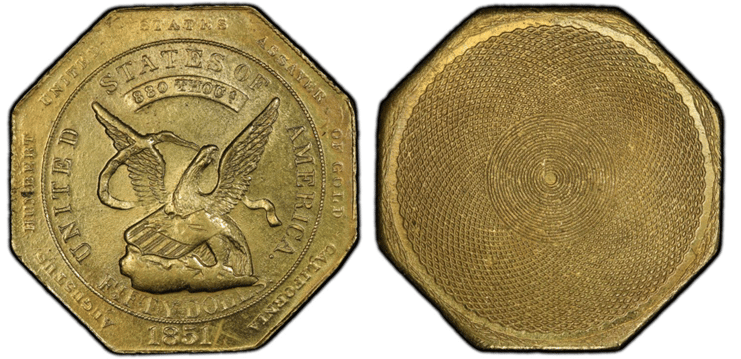
The next one is identical, except it has a fineness of 0.887.
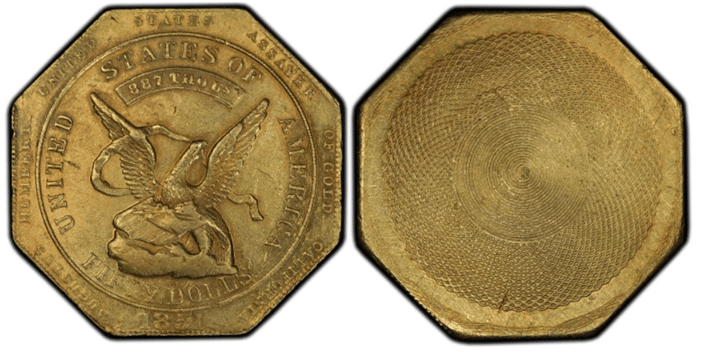
The last example he struck was dated 1852, had a fineness of 0.887, and, again, a “target” reverse.
While Humbert slugs circulated and were generally accepted, acceptance was not universal and depended on trust in the assayer and local conditions. Expand your collection today and shop our assortment of California fractional and territorial gold coins.