

About Dubosq and Company
The firm of Dubosq & Company was founded by Theodore Dubosq Sr., a jeweler from Philadelphia. On the ship Grey Eagle, Dubosq brought machinery for melting gold dust and ore, a coining press, and other necessary equipment, along with his sons, Theodore Dubosq, Jr., and Henry A. Dubosq. The need for striking private gold coins was immense in California at the time, and Dubosq and his equipment arrived there in 1849.
The only 1849-dated Dubosq pieces are copper pattern strikes of the $2.50 and $5 denominations; all known gold coins produced by the firm are dated 1850. Some numismatists suspect that United States Mint Engraver James B. Longacre may have engraved the 1850 Dubosq issues. The reasons are that they bear a striking similarity to the federal coins of that era and that Longacre had several Dubosq pattern coins in his estate. Did he create them or did he buy them as a novelty? No one knows for certain.
Augustus Humbert’s Assay
Dubosq & Company coins were assayed at $9.93 for an eagle and $4.96 for a half eagle by assayer Augustus Humbert. Dubosq historically claimed that the coins contained a silver alloy that added intrinsic value not measured by Humbert’s assay. He argued that this untested silver should command a bullion value higher than Humbert reported. Humbert stated he did not assay the silver in the coins because, in his view at the time, the cost to separate (part) the silver from the gold exceeded its market value, so he treated the silver as having negligible practical value for the assay results.
Most Dubosq and Company coins were melted after 1851, following Humbert’s assay. The company operated primarily during 1850 and into early 1851, and Theodore Jr. sold the firm’s dies and equipment to Wass, Molitor & Co. before returning to Philadelphia.
Coin Details
The coins resembled their federal counterparts (the $5 Liberty Half Eagle Coin and $10 Liberty Eagle Coin), with Lady Liberty facing left on the obverse. 13 six-pointed stars surrounded the periphery, and the date appeared at the bottom. “DUBOSQ & CO” was on Lady Liberty’s coronet. The $5 and $10 gold coins share the same design, differing only in the denomination on the reverse.
The reverse of the coins featured an eagle with upstretched wings, an olive branch, and arrows in either talon. Around the periphery of the reverse were the words “S. M. V. CALIFORNIA GOLD” and the denomination at the bottom “FIVE D.” or “TEN D.”
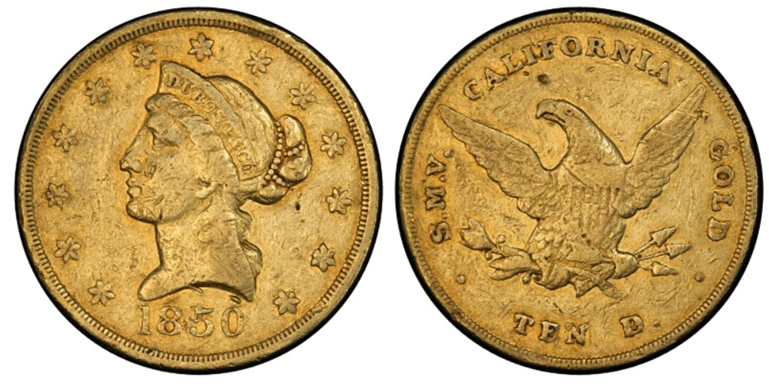
A newspaper of that era, the Alta California, reported that Dubosq and Company produced approximately 10,000 $10.00 gold coins and 10,000 $5.00-denominated coins, totaling $150,000 in face value. A few $5.00 and $10.00 gold coins are known today, such as the 1852 Wass, Molitor & Co. ten-dollar gold piece, which was recovered from the wreck of the S.S. Central America, which sank on September 12, 1857. The coin was made with a Dubosq & Co. die. The number of surviving copper coins is unknown.
Expand your collection today and shop our assortment of California fractional and territorial gold coins.