
About John Haskins Bowie & the Famous Bowie Family
Joseph Haskins Bowie was a former silversmith from Baltimore before founding the J. H. Bowie Company, and was born in Georgetown, Washington, D.C., on January 25, 1816. Joseph Haskins Bowie was a member of the extended Bowie family, a family with several members who played notable roles in American life during the 19th century.
Among the various branches of the Bowie family, James ‘Jim’ Bowie emerged as one of the most famous figures; while both he and Joseph Haskins Bowie shared extended family origins, the exact degree of their kinship is not clearly documented. Jim Bowie gained enduring fame for his role in the Texas Revolution and his death at the Battle of the Alamo in 1836. His reputation as a fearless fighter, combined with frontier storytelling, elevated the Bowie name into American folklore.
Closely tied to this legacy is the Bowie knife, a large fighting knife popularly attributed to Jim Bowie. While the precise smith credited with creating the first Bowie knife and the earliest formal design history remain debated, early published descriptions from 1829 contributed to its association with Jim Bowie. By the mid-19th century, the Bowie knife had become a symbolic artifact of rugged individualism, frontier justice, and expansionist America.
It is believed that Joseph Haskins Bowie brought coinage dies with him on this transcontinental journey, but coining presses and other equipment would not have survived the journey. It is also presumed that the dies for the Bowie coins were engraved by Baltimore Jeweler George W. Weber. J. H. Bowie Company was established in 1849 in California.
Coin Design Details
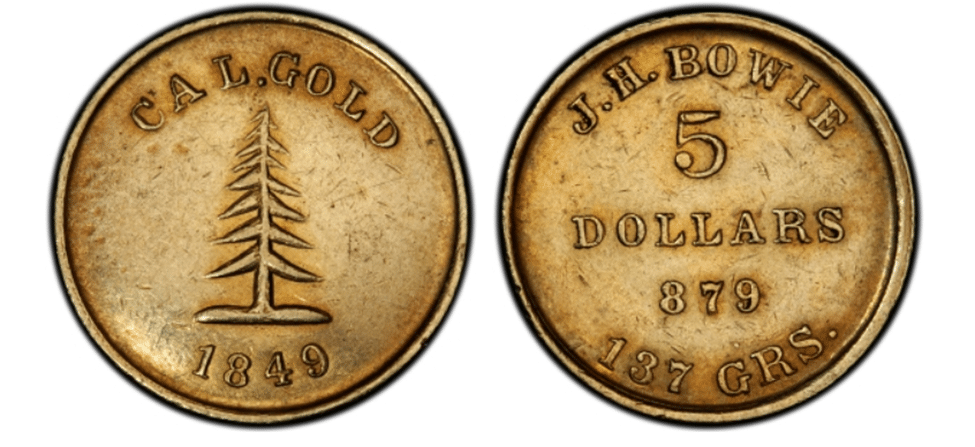
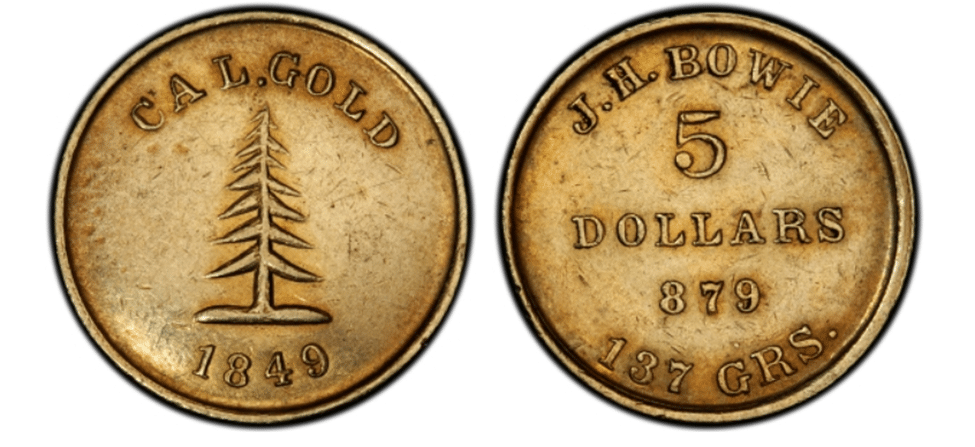
The design of the Bowie gold coins is simple. The obverse has a crude pine tree as the central vignette with “CAL. GOLD” above and the date “1849” below. The reverse has “5 DOLLARS” in the center on 2 lines with his name along the top periphery, “J. H. BOWIE” and the fineness “879” below the denomination and the weight “137 GRS.” at the bottom periphery.
Another version was struck alongside the gold coin. A $1 Copper coin was also struck but is thought to be unique. The design is similar except for the size, denomination, and metallic composition.
While it is unknown how many $5 Gold Coins were actually struck, only a few specimens are known to exist today. Although the coins contained a high percentage of gold, their intrinsic value was close to, but not conclusively above, face value based on weight and fineness. It is likely that the overwhelming majority of coins produced were melted for their gold content, which ensured a considerable profit for their owners. The coins produced by J. H. Bowie are considered among the rarest of the California Gold Rush era.
After living for some time in California, Mexico, and Texas, Bowie finally settled in Illinois. He died on January 5, 1879, while visiting St. Louis, Missouri. Bowie’s coins are highly prized today due to their extreme rarity and connection to the formative years of California’s monetary history. Expand your collection today and shop our assortment of California fractional and territorial gold coins and pre-1933 U.S. gold coins.