
About the Historic J. S. Ormsby and Company
J. S. Ormsby & Company was among the earliest private mints in Sacramento, California, and its establishment was among the more prominent early issuers of private California gold. The firm was run by Dr. John S. Ormsby, his brother Major William M. Ormsby, and a clerk named O. H. Pierson. (These are documented names.) The brothers left St. Joseph, MO, for California in April of 1849 by wagon train. Arriving in Sacramento in late September 1849, they set up a gold minting company and began striking their own private gold coinage.
The California Gold Rush brought a surge of prospectors and gold dust to the area, but there was very limited official coinage available for trade and commerce. In that environment, private enterprises like Ormsby’s struck coins to fill the gap. These pieces were not federal issues and didn’t carry legal tender status, but they circulated locally due to necessity and convenience.
The coins were allegedly struck by the old-fashioned method of using dies and a sledgehammer. The gold planchets they created for their coinage were poorly annealed (heated), which made them non-uniform. They had difficulty refining the gold properly, so they hired William W. Light, a dental surgeon, to improve the melting and annealing process, although he soon left to pursue mining.
Rather than locating themselves in San Francisco, the Ormsbys were closer to the actual gold miners, and that proximity brought substantial business to the company. Their $10 gold coins were underweight and of lower fineness, giving them an intrinsic value significantly below face value. Most private mints in this period designed their coins to resemble high-circulation federal coinage, but J. S. Ormsby & Company created a unique design. The majority of coins were struck in late 1849, as by 1850, J. S. Ormsby & Company had ceased operations. The Ormsby coins were taken to assay offices and melted in large quantities.
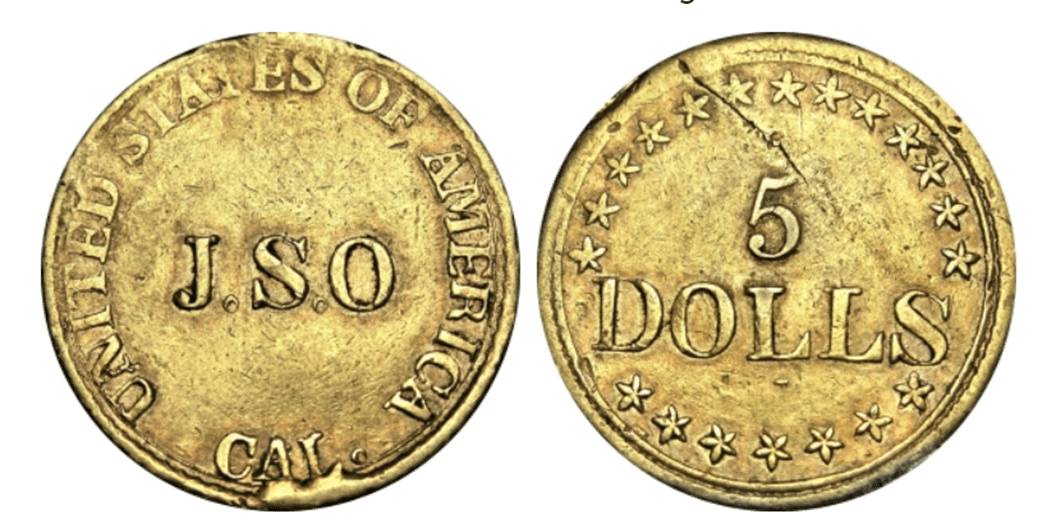
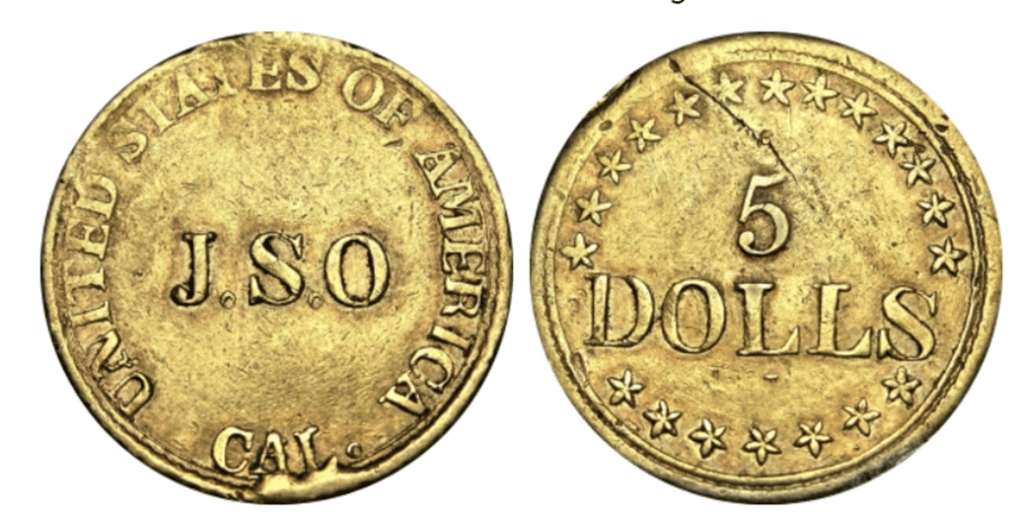
J. S. Ormsby & Company $5.00 Gold Coins
The obverse of the $5.00 Gold coins had “J. S. O.” in the center of the planchet. The periphery displayed “UNITED STATES OF AMERICA” and “CAL.” at the bottom periphery. The reverse of these coins has the denomination “5 DOLLS” in two lines at the center of the coin. Surrounding the periphery were 20 5-pointed stars.
J. S. Ormsby & Company $10.00 Gold Coins
The $10 coin had 31 stars, suggesting California had already joined the Union. If that were correct, the coin could not have been issued before 1850. In 1911, however, a $5 Ormsby specimen surfaced with only 20 stars. The stars on the $10 piece may have been purely decorative or experimental, or Dr. Ormsby might have updated the larger die in anticipation of California’s admission. The exact positioning of the denomination, stars, and legends differs between the $5 and $10 denominations because each was struck from separately engraved dies, with additional variation introduced by primitive hand-striking methods.
There are as few as five known specimens of Ormsby gold coinage known today between the $5 and $10 denominations. Expand your collection today and shop pre-1933 U.S. gold coins.