
The Massachusetts and California Company
When the Gold Fever struck in California in 1849, people across the country were captivated and sought their share. People in New England were no different. Numerous groups banded together to go there and mine for gold. People invested in “shares” of these companies, hoping their company would become profitable. In Massachusetts alone, it’s said that over 100 companies were organized.
The Massachusetts and California Company decided that, rather than engaging in mining and prospecting, there was an important need in California for converting gold ore and dust into minted coins, and they sought to fill that void. They purchased a machine capable of producing $10,000 worth of $5 face-value coins per day, provided they had a steady supply of gold dust. With investment and pledges totaling $50,000, the company was established in 1849; directors were appointed, and management shipped personnel and coin-making machinery to California. At the time, private mints were allowed to operate and create their own coinage out of necessity, and private coinage was not officially authorized by the U.S. government.
The newspaper, the Northampton Courier, published this in March 1849: “Under this title [Massachusetts and California Company] a company has been organized in Northampton, Mass., for the purpose of establishing in California a private Mint, something like that of Christopher Bechtler in North Carolina . . . [whose coins] will be actually worth a share more than the corresponding U.S. coins.”
Rarity of the Massachusetts and California Company’s Gold Coins
While we know that the founders of the Massachusetts and California Company reached California, reports suggest the expedition’s equipment may have been lost, damaged, or sold en route, but the precise fate is not fully documented. Despite that, the Massachusetts and California Company gold coinage was still made. The coins were likely produced in Northampton, Massachusetts, where the company was headquartered, and the town was well equipped to produce metals and metallic products.
Today’s numismatists note that surviving Massachusetts & California Company pieces use a gold-copper alloy similar to that used by the U.S. Mint, and California private issues also typically used gold-copper alloys.
Only a very small handful of these coins exist today, and some speculate that many were melted when the company dissolved in 1854, only five years after its founding. In addition to gold, silver and copper test strikes or medallic impressions have been recorded, likely used to test dies or demonstrate patterns. Two $10 brass pieces are known, though no gold $10 coins are documented.
1849 $5 Massachusetts & California Company Gold Coin Details
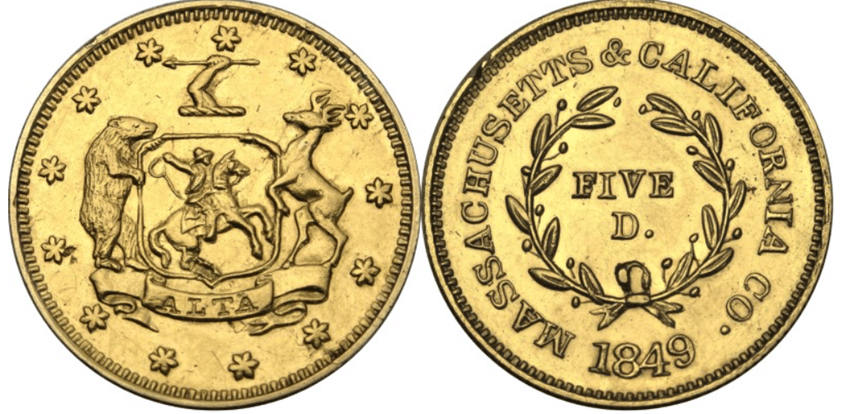
The Massachusetts and California Company gold coins were nicely executed, and most reported no die issues. The obverse was a combination of Massachusetts symbols, an arm holding a spear, and a deer, combined with a California golden bear and a man on horseback in the center. The reverse has the denomination in the center in “FIVE D.” on two lines, inside a wreath, with “MASSACHUSETTS & CALIFORNIA CO. 1849” around the periphery.
Expand your collection today and shop other pre-1933 U.S. gold coins.