
History of Norris, Gregg, & Norris
As gold was discovered in 1848 at Sutter’s Mill in Coloma, California, one of the first companies to capitalize on the gold rush was Norris, Gregg & Norris in Benicia, California. Their private gold coinage was reported in local newspapers on May 31, 1849.
The 19th-century San Francisco newspaper, Alta California, stated, “We have in our possession a Five Dollar gold coin, struck at Benicia City, although the imprint is San Francisco. In general appearance, it resembles the United States coin of the same value, but it bears the private stamp of “Norris, Grieg & Norris”, and is in other particulars widely different.” It is unknown today whether Norris, Gregg & Norris had a minting facility in Benicia, but it is assumed they did.
$5 Gold Coin Details
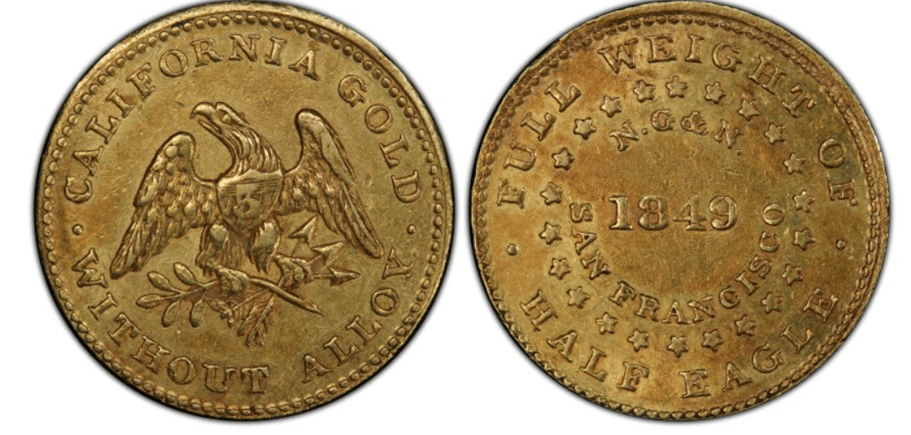
Norris, Gregg & Norris struck different types of $5 Gold Half Eagles. The first type of coin had an obverse with a central vignette of an eagle with its wings spread downward. On the eagle’s breast is an American shield, and the number “5” represents the denomination. The eagle has an olive branch in one claw and three arrows in the other. Around the periphery of the obverse was “CALIFORNIA GOLD. WITHOUT ALLOY.”
The reverse of the coin was entirely text, with “1849” centered. Around the date, “N. G. & N.” appeared above and “SAN FRANCISCO” below. This was surrounded by 22 five-pointed stars. This coin had a Plain Edge.
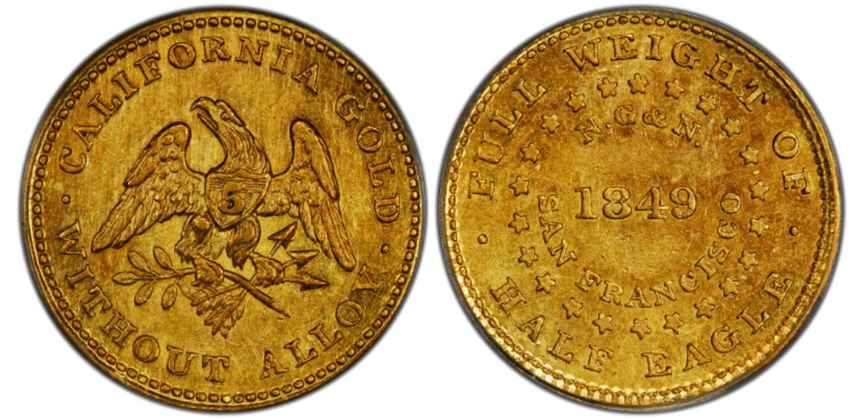
The next type of Norris, Gregg & Norris Half Eagle had the exact same design but had a reeded edge.
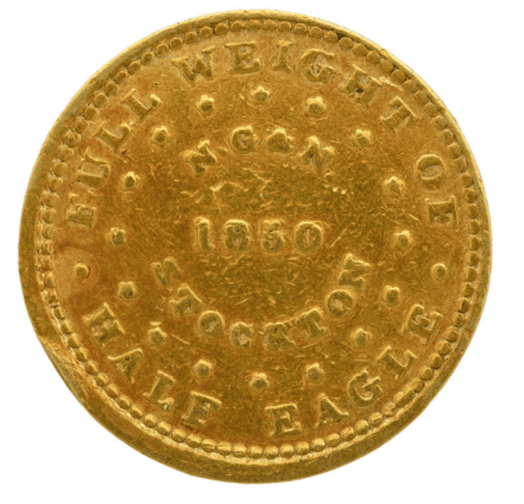
The third and final type is identical to the two more common types, but remains very scarce: instead of stating “SAN FRANCISCO” under the “1849” date on the reverse, this piece has replaced San Francisco with “STOCKTON”. Only one piece is known, and it resides in the National Coin Collection of the Smithsonian Institution, in Washington DC.
The coins were generally well received by residents of and visitors to San Francisco and traded at par with federal coinage. While some sought to discourage the local populace from accepting the Norris, Gregg & Norris coinage by questioning its actual value in contemporary newspapers, the firm responded by defending its coinage as superior to Federal coins.
Norris (himself) replied that the coinage bearing his name was “pure of any placer gold” and “contained no alloy whatsoever.” In addition, he stated that his coinage would “weigh 1% HEAVIER than the U.S. Half Eagles” and that his coinage sold “in Boston, New York, Philadelphia, and New Orleans at a premium of 1% (more than the US Coins).”
Norris, Gregg & Norris (San Francisco) coinage is scarce and highly desireable by collectors, given that it was likely the first private coinage in California. Expand your collection today and shop pre-1933 U.S. gold coins.