

The Kentucky Token is a well-known post-Revolutionary token that uses early U.S. state symbolism, despite being struck in England. Most references attribute their manufacture to England in the early 1790s, roughly 1792 to 1794, when private token production flourished on both sides of the Atlantic.
They are called Kentucky tokens for a simple visual reason: at the top of the reverse design sits a star marked with a “K”, interpreted as Kentucky, the fifteenth state, admitted to the Union in 1792. Whether the placement was deliberate or coincidental remains uncertain, the “K” at the apex became the shorthand name for the entire type.
Design and Messages
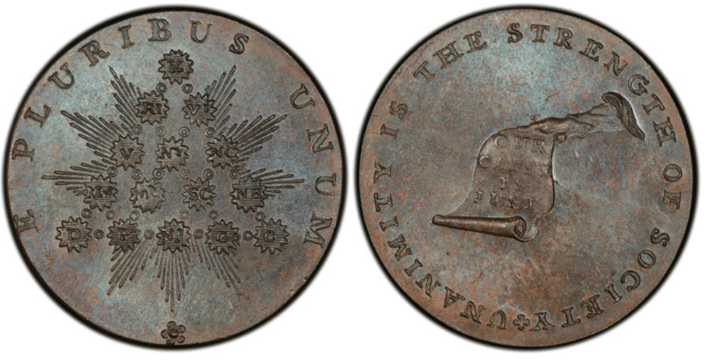
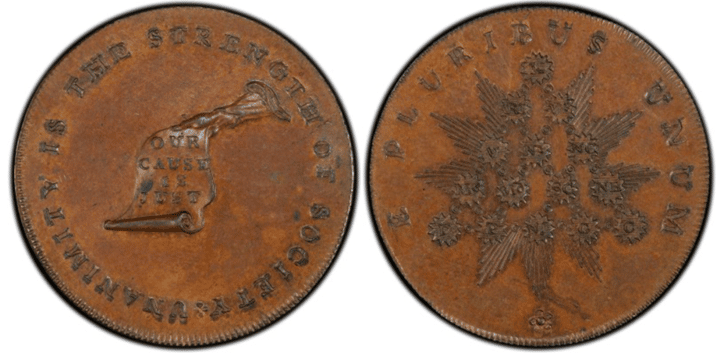
The obverse centers on a political motto. It shows a hand holding an open scroll inscribed “OUR CAUSE IS JUST”, a phrase that resonates with Revolutionary-era rhetoric and the young republic’s insistence on unity and legitimacy. Around the outer border appears the longer maxim, “UNANIMITY IS THE STRENGTH OF SOCIETY”, a statement that frames the token as more than a commercial surrogate. It reads like a civic reminder at a time when the nation was still defining itself.
The reverse delivers the theme visually. Fifteen stars are arranged in a pyramid, each star rendered with points and surrounded by radiating lines, and the stars are linked together by chain-like connectors. The effect is deliberate: separate units bound into a single structure. Around the periphery runs the familiar national motto “E PLURIBUS UNUM”.
Each star carries the initial of a state, adding a geographic key to the design. The arrangement is typically described in five rows, with Kentucky at the top and the remaining initials stepping downward in a fixed order. One commonly described arrangement reads: top row K; second row RI and VI; third row V, NC, NY; fourth row MS, MD, SC, NH; and bottom row D, P, NJ, G, C. These initials correspond to the thirteen original states plus Vermont (1791) and Kentucky (1792), presented as a 15-state union.
Five Major Varieties and the Circulation Debate
Collectors generally organize Kentucky Tokens by edge, because the central devices remain consistent while the edges signal different intents and audiences. Collectors recognize five main edge varieties:
- Plain Edge
- Engrailed Edge
- Lettered Edge: “PAYABLE IN LANCASTER, LONDON OR BRISTOL”
- Lettered Edge: “PAYABLE AT I. FIELDINGS MANCHESTER”
- Lettered Edge: “PAYABLE AT BEDWORTH, NUNEATON OR HINKLEY”
In addition to those five major types, there are also rarer edge varieties (such as W. Parker, Birmingham, and vine/twin-leaf edge types). A long-running debate concerns whether these were intended mainly for American circulation or for Britain’s token-collecting market. Some have suggested that plain-edge pieces more often show circulation wear, while many lettered-edge examples survive with less wear, though exceptions exist and intent cannot be proven from wear alone.
Some researchers argue that certain varieties were aimed at Britain’s late-18th-century token market (often grouped under the ‘Conder token’ umbrella), with certain lettered or unusual edge types appearing to have been made in smaller quantities and frequently surviving in higher grades.
The Kentucky Token series illustrates a transitional period: a young United States inspiring imagery and mottos abroad, English token-makers responding to demand, and later collectors sorting the results into varieties that reflect both circulation realities and collector-driven production.