
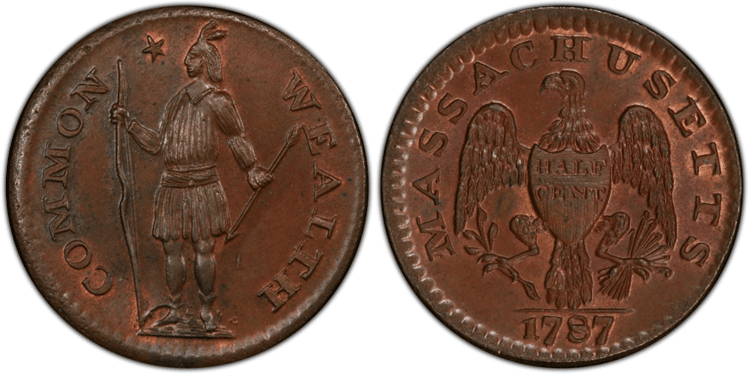
In the late 1780s, Massachusetts faced the same practical challenge that confronted much of the young United States: a chronic shortage of dependable small change. Foreign coins, worn coppers, and a mix of local substitutes filled the gap, but they did not provide the kind of uniform, trustworthy coinage that a growing commercial economy needed. Massachusetts had already experimented with copper issues in extremely limited numbers, and by 1786 state leaders were confident enough to take a larger step. The result was a notable state-authorized coinage of the Confederation period: the Massachusetts cents and half cents dated 1787 and 1788.
Creating a State Mint in Boston
On October 16–17, 1786, Massachusetts enacted “An Act for establishing a mint for the coinage of gold, silver and copper” authorizing a state-owned mint. This act passed the House on the 16th and passed the Senate and Governor John Hancock on the 17th. Construction of the mint soon followed with Captain Joshua Wetherle, a Boston goldsmith and a captain in the Massachusetts militia, appointed mintmaster and placed in charge of producing the Commonwealth’s copper coinage.
This matters because the half-cent denomination later became a th part of early federal coinage, and Massachusetts was among the first to employ it in a structured, state-authorized way. In practice, these pieces were conceived as everyday working coins, meant to circulate broadly and ease daily commerce rather than serve as commemorative issues.
The plan, however, ran into a problem that often undermined early minting ventures: cost. Initial estimates excluded die preparation and the sheer number of dies needed to finish the run. When these realities were included, the true costs of manufacture rose sharply, ultimately exceeding what policymakers had expected. In fact, the final cost came in at more than double the face value per coin.
Design Standards, Varieties, and Circulation
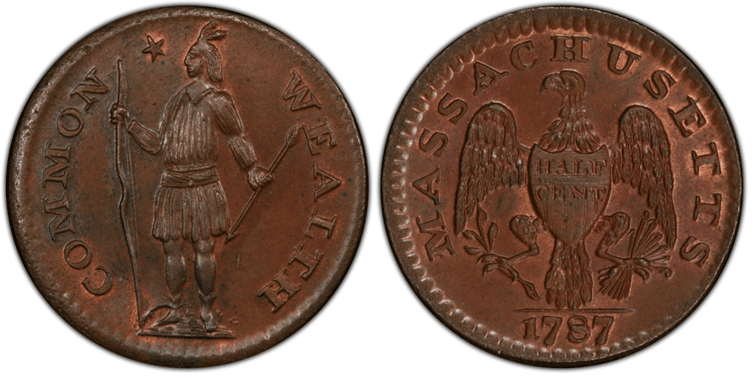
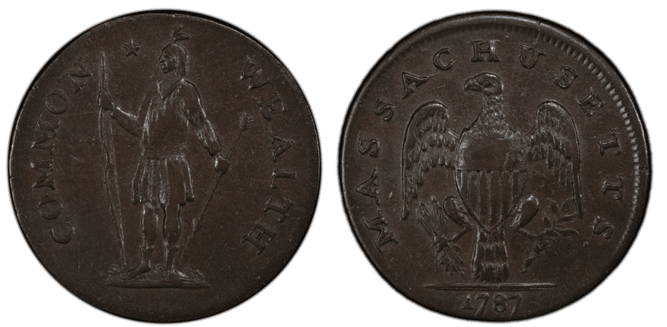
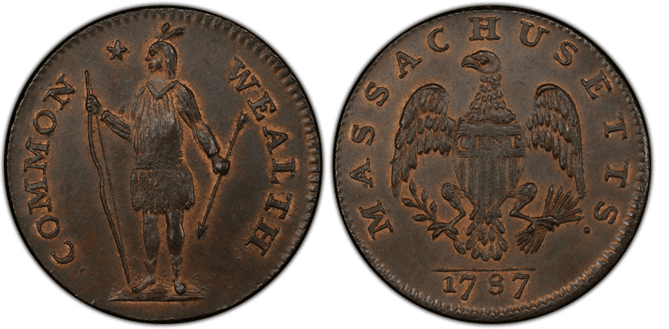
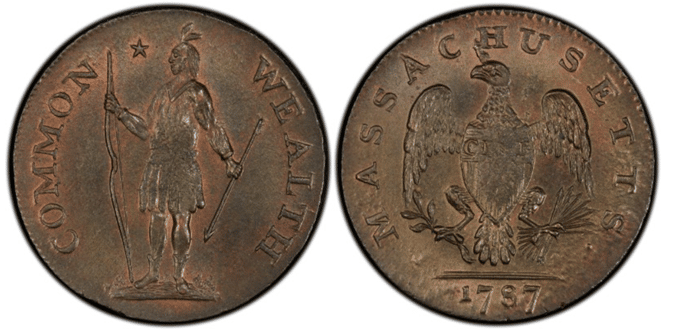
The act also dictated the basic design, ensuring that the coinage would be distinctly “Massachusetts” in both imagery and legends. The obverse was to depict a Native American holding a bow and arrow, with a star separating the words “COMMON” and “WEALTH” above. The reverse was to feature a large American bald eagle with wings spread and a shield on its chest. On that shield, the denomination would appear as “CENT” or “HALF CENT” on two lines, with “MASSACHUSETTS” and the date, either 1787 or 1788, around the periphery.
Die work initially involved Joseph Callender, a State Street engraver who had apprenticed to Nathaniel Hurd and later worked as a journeyman in Paul Revere’s shop. Callender’s pricing, however, proved too high, and the contract shifted to Jacob Perkins, a 22-year-old engraver from Newburyport on the North Shore. Perkins’ involvement is significant because it reflects how quickly talented private craftsmen could be drawn into major public projects during this era.
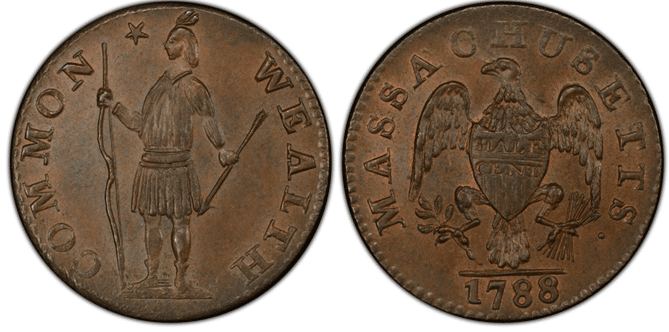
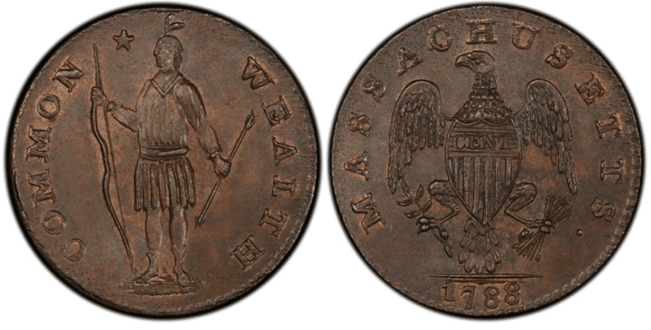
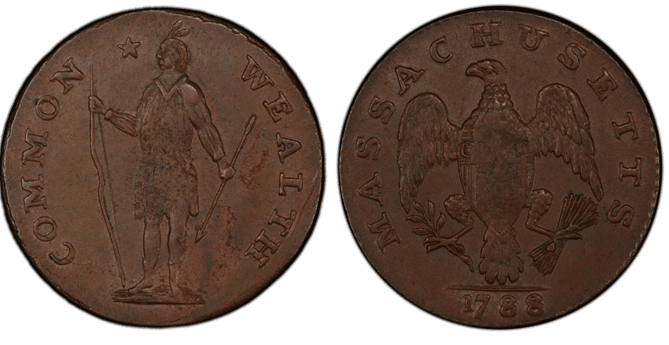
The first coin reportedly struck at the new mint was the 1787 Massachusetts half cent. The 1788 copper coinage then settled into three major types: the 1788 half cent, the 1788 cent with a period after “Massachusetts”, and the 1788 cent with no period after “Massachusetts”. The 1787 cent is also collected by major variety, including a very rare type with arrows in the eagle’s right talon, a type with arrows in the left talon, and the well-known “horned eagle,” created by a die break that altered the eagle’s appearance.
Despite the financial strains, the finished coins show careful workmanship. Struck on high-quality copper planchets, they were widely accepted and circulated for decades, even turning up beyond Massachusetts in neighboring states. Production is commonly estimated at roughly 110,000 half cents and about 300,000 cents, for a combined total near 400,000 coins.
Massachusetts’ minting experiment ended almost as soon as it began. On November 17, 1788, the Commonwealth ordered the mint closed once its existing copper supply was exhausted. On November 17, 1788, the Commonwealth voted to close the mint once the remaining copper was used up, and the operation finally closed on January 23, 1789. The shutdown reflected the project’s poor economics and came as the new Constitution (soon to take effect in 1789) would bar states from coining money going forward. Even so, Massachusetts cents and half cents remain a compact, historically rich series, with one standout obstacle for collectors: the scarce 1787 cent with arrows in the right talon.