
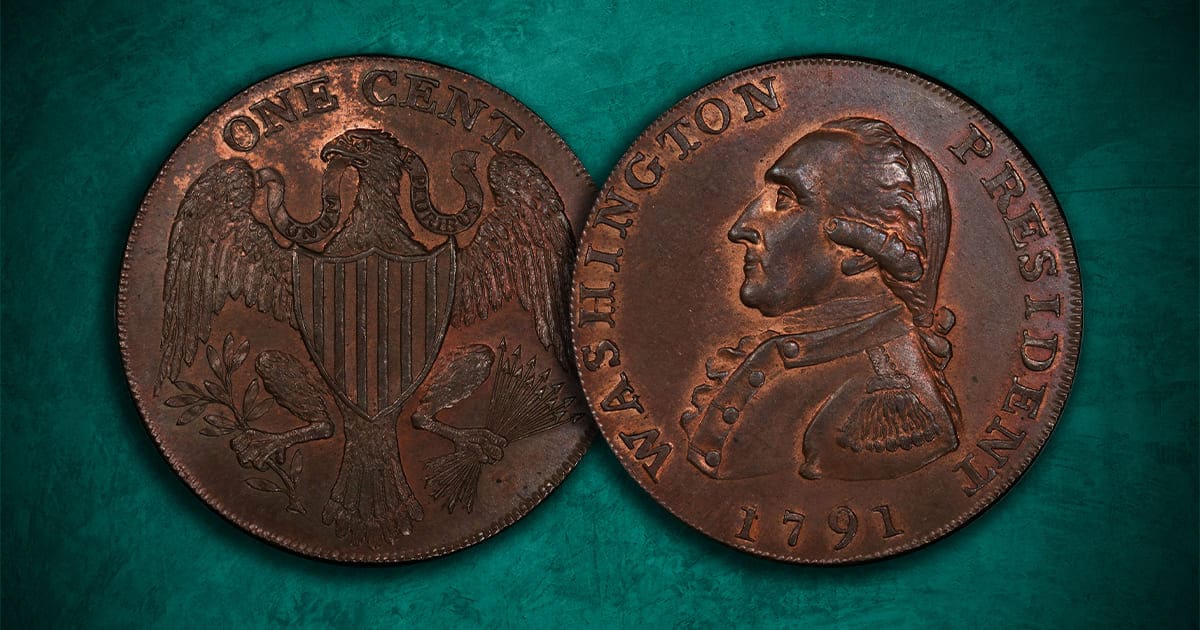
The 1791 Washington Cent is an early privately produced coin created before the establishment of the United States Mint. Although it was never adopted as official U.S. coinage, it remains an important piece of early American numismatic history and reflects debates about national identity, coin design, and monetary sovereignty.
In the years immediately following the Revolutionary War, the United States faced a practical problem with political implications: the new nation had no standardized coinage of its own. Everyday commerce relied on a mixed stream of foreign silver, British copper, state issues, and a growing number of private tokens. Merchants and consumers could usually find something to trade with, but the system was uneven and vulnerable to counterfeits and underweight pieces.
In that environment, several parties attempted to anticipate what national American coins might look like and produced pieces intended to serve as prototypes. The 1791 Washington Cent is one of the most notable of those privately produced, government-aspirational issues.
Who Commissioned the Coin and Why
A British firm, W. and Alexander Walker, commissioned engraver John Gregory Hancock to design copper cents that might appeal to American officials. They planned to create well-executed cent pieces with American-themed designs, distribute them to influential decision makers, and secure a contract to supply coinage for a country that needed additional small-denomination currency.
From a business perspective, the timing made sense. The United States had not yet established a functioning federal mint, and the demand for reliable copper coinage was obvious. From an American political perspective, however, the arrangement was controversial. Even before the designs were reviewed, the concept of foreign-made “contract coinage” touched a nerve in a nation newly sensitive to sovereignty and symbolism.
The Three Related Variations: Large Eagle, Small Eagle, and Die Trials
Collectors generally recognize three related versions of the 1791 Washington Cent:
- Large Eagle Cent – Features Washington’s bust with a large heraldic eagle on the reverse.
- Small Eagle Cent – Uses a similar Washington portrait but with a smaller eagle and the date moved to the reverse.
- Uniface Die Trials – Experimental strikes showing individual obverse or reverse dies.
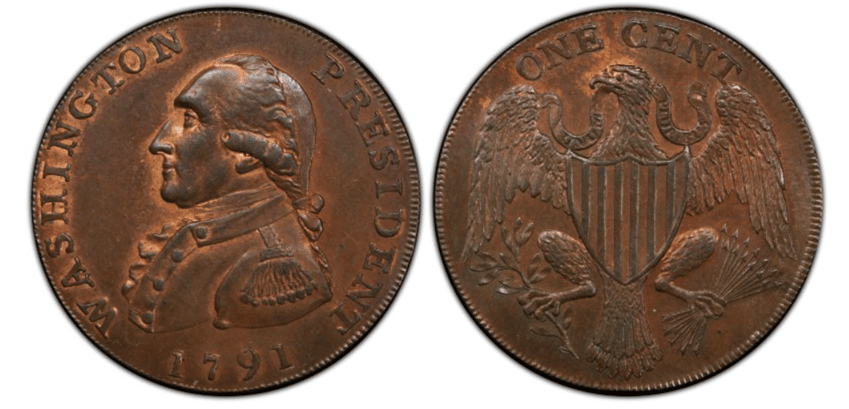
Large Eagle Cent
The Large Eagle Cent places Washington front and center on the obverse. It shows a military bust of Washington facing left, with “WASHINGTON” along the left side and “PRESIDENT” along the right. The date “1791” appears below the bust.
The reverse features a large heraldic eagle facing left, holding a banner in its beak inscribed “E PLURIBUS UNUM.” The eagle’s breast is covered by a patriotic shield with vertical striping. In one talon are arrows, in the other an olive branch, pairing military readiness with the hope of peace. The denomination “ONE CENT” appears above.
Washington appears as the central figure, accompanied by an eagle motif commonly associated with independence and federal authority.
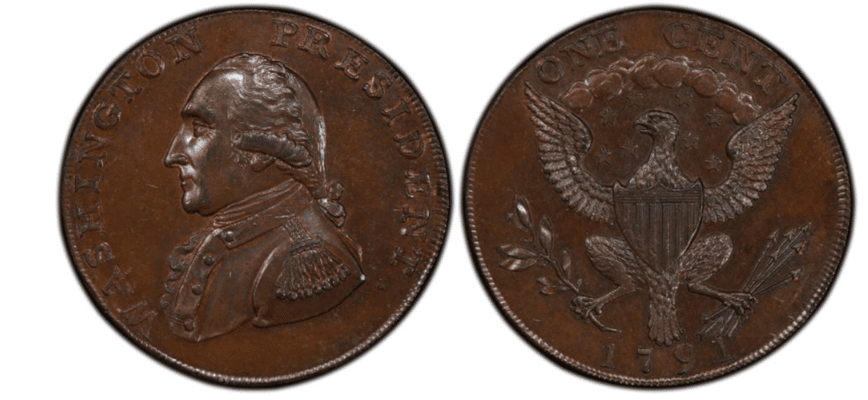
Small Eagle Cent
The Small Eagle Cent keeps the same basic Washington obverse concept, again depicting him facing left in military dress with “WASHINGTON” and “PRESIDENT” around the periphery. One key difference is the location of the date. Instead of appearing on the obverse, the date “1791” is moved to the reverse.
The reverse presents a smaller eagle with upraised wings and a more complex shield arrangement. Above the eagle are stars, with clouds above the stars, and “ONE CENT” appears above that upper device. The arrows and olive branch appear again, though the eagle’s armament is reduced compared to the Large Eagle type. The change in scale and details gives the Small Eagle Cent a lighter, more compact look, while still clearly presenting a national emblem.
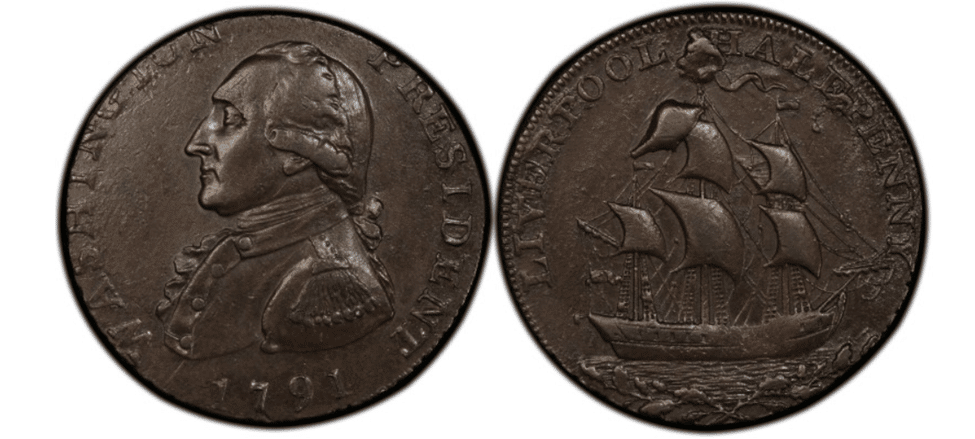
Uniface Die Trials and Related Pieces
In addition to the two principal cents, uniface die trials exist for both obverses and reverses. These are important because they show that separate obverse and reverse dies were prepared and tested, reinforcing that the designs advanced beyond a purely conceptual stage.
There is also an important afterlife to these designs. When the cent concepts failed to gain official acceptance, parts of the design were reused on other token issues. A notable example is the reuse of the Washington obverse from the Large Eagle cent on a Liverpool halfpenny token, an effort to salvage an attractive portrait and repurpose it in the broader British token market.
Distribution to American Officials
A wooden cask containing about 4,000 of these cents was shipped to Philadelphia. The pieces were then distributed to individuals close to the center of federal power, including members of Washington’s cabinet as well as Senators and Congressmen. The distribution strategy functioned as a marketing effort aimed at policy makers.
A frequently cited breakdown suggests roughly 2,500 Large Eagle coppers and 1,500 Small Eagle coppers were included. Regardless of the exact split, this was a large enough group to demonstrate capability and create discussion, but small enough to remain an “evaluation” issue rather than a circulating national coinage.
Why Washington Rejected the Design
The Washington Cents failed for reasons that went far beyond engraving quality Contemporary descriptions suggest the portrait and eagle devices were well executed and clearly patriotic in theme.
First, he did not want his likeness on coinage. Washington viewed the practice of placing a leader’s portrait on money as a monarchial tradition. After fighting a war to separate from a monarchy, he did not want the new republic to resemble the political culture it had rejected. Even if Congress and the public might have accepted the design, Washington’s personal stance carried enormous weight, and he was unwilling to compromise.
Second, the proposal also conflicted with the broader push for an American-controlled coinage system. While Washington is most directly associated with rejecting the portrait as too monarchical, the idea of relying on privately produced British coinage sat uneasily with emerging American notions of monetary sovereignty.
To Washington, a national mint and national coinage were not optional details. They were part of what made the United States a sovereign entity. A privately produced British issue, no matter how handsome, conflicted with that vision.
Circulation, Survival, and Collecting Interest
Despite rejection at the highest level, the Washington cents did not vanish. Some pieces circulated, aided by the general shortage of copper coinage and the fact that copper tokens often passed by weight and general acceptance rather than strict legal authority. Others survived because they were retained as souvenirs by the officials who received them or by collectors who recognized their novelty.
Today, the 1791 Washington Cents are widely collected as part of Washington-themed early American material. They are historically interesting not because they became official, but because they illustrate the debates of the era: what belongs on American money, who should manufacture it, and how a young republic should visually distinguish itself from the monarchies of Europe.