
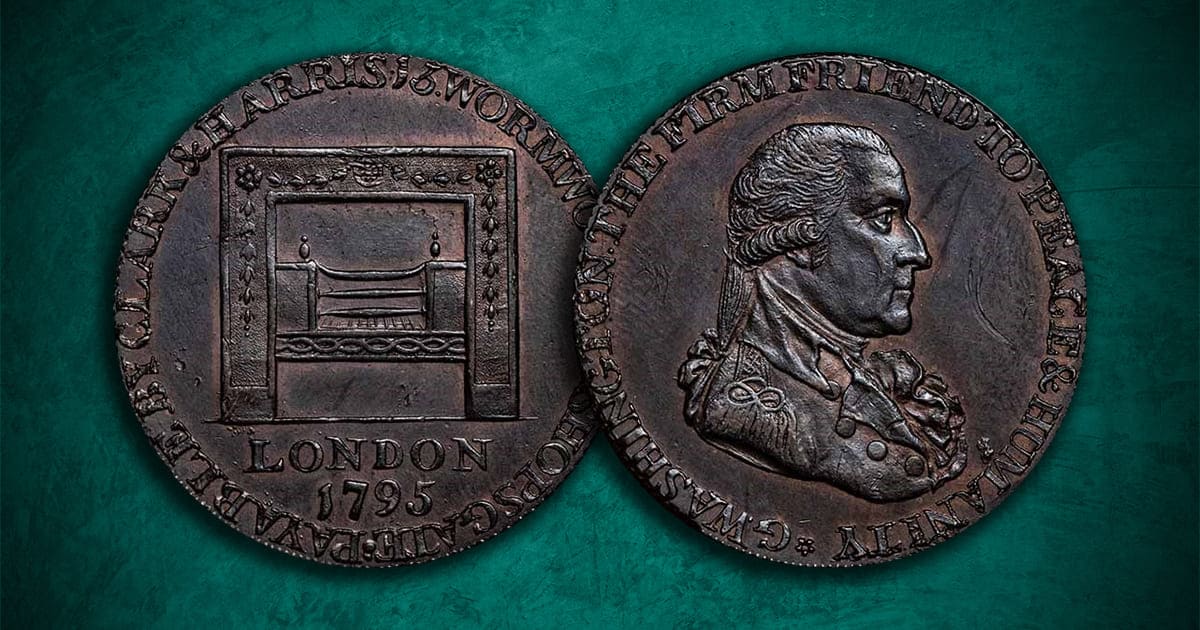
During Britain’s late-18th-century provincial token era, private issuers produced copper halfpenny tokens for English circulation, some featuring American themes. A famous example is the 1795 Washington Grate Halfpenny, a trade token sed as a halfpenny, which pairs a Washington portrait with an advertisement for the London firm Clark & Harris. Although it was made for circulation in England, the subject matter and Washington portrait have long caused the token to be collected alongside American colonial and early federal-era pieces. It is a reminder that American numismatic history is not limited to coins produced by the United States Mint.
Who Made It, and Why the “Grate” Matters
The Washington Grate Halfpenny was designed by Thomas Wyon (often identified as Thomas Wyon Sr.), a prominent British engraver. Though widely used as and called a halfpenny, the token was produced for the London firm Clark & Harris. The firm was known as exporters of stoves and fireplace screens, commonly called grates. In other words, the reverse is not symbolic in the way many early tokens were. It is direct advertising, using an ornate fireplace grate as the central vignette.
This was a practical marketing decision. Washington’s reputation, even abroad, carried significant cultural weight. By placing his bust on a piece intended to circulate as a halfpenny token, the issuer created something that could pass hand to hand while repeatedly advertising a business address. The result is a trade token that functions like a circulating business card, but one with real monetary utility in its day.
Designs, Legends, and Recognizable Varieties
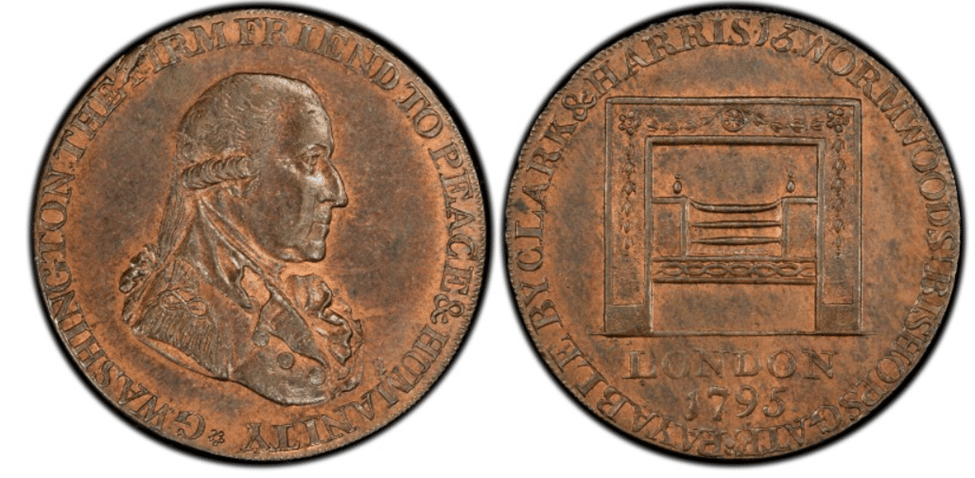
The obverse shows a smaller military bust of George Washington facing right. Around the periphery is the inscription “G. WASHINGTON. THE FIRM FRIEND TO PEACE & HUMANITY”.
That legend is important because it frames Washington not as a monarch or conqueror, but as a stabilizing public figure associated with civic virtue. The reverse shows a fireplace grate with a commercial legend around it reading “PAYABLE BY CLARK & HARRIS • 13 WORMWOOD ST • BISHOPSGATE”, with “LONDON” and the date in the exergue.
The address and “payable by” language signals that the issuer stood behind the token’s value in trade, a familiar structure for late 18th-century British commercial tokens.
There are multiple varieties of the Washington Grate Token. The best-known distinction is the Large Button versus the scarcer Small Button variety, referencing the buttons on Washington’s military tunic. Large Button pieces are seen with either a diagonally reeded (milled) edge or a lettered edge. The lettered edge reads “PAYABLE AT LONDON LIVERPOOL OR BRISTOL”.
That edge inscription matters because it expands the implied redemption footprint beyond a single address, reinforcing how tokens could be integrated into broader commercial networks.
Circulation & Collectability
Historically, these tokens circulated in England as spendable copper halfpennies. Yet they are widely collected today as part of American colonial token sets because Washington’s portrait ties them directly to early United States iconography. For collectors, this dual identity is the appeal: a British-made commercial token that still feels like an early “Washington” issue.
Most surviving examples are encountered in middle circulated grades, which makes sense for a token that served as an accepted halfpenny. All three primary varieties are considered collectible, and the set of Large Button (plain edge), Large Button (lettered edge), and Small Button gives collectors a structured, attainable way to pursue the type while still rewarding variety hunting.