
The 125th Anniversary of the Founding of Yellowstone Park
Before the United States took possession of the land that now comprises Yellowstone, many Native American tribes occupied it. For centuries, the Crow Nation lived just east of what is now Yellowstone National Park, while the Blackfeet thrived to the north. Each year, Shoshone, Bannock, and other plateau tribes crossed the region to hunt on the eastern plains. Other Shoshonean groups pursued game in the open lands west and south of Yellowstone. They visited geysers, held ceremonies, foraged for plants and minerals, traded goods, and walked the very paths still preserved in the park today.
In 1872, President Ulysses S. Grant established Yellowstone National Park as America’s first national park. When Grant signed the Yellowstone National Park Protection Act in 1872, he helped protect the timber, mineral deposits, and natural curiosities of present-day Wyoming, Montana, and Idaho; however, simultaneously ending Indigenous occupation in the land. Native Americans were removed with systemic displacement policies.
Today, this national park is famous for its incredible geothermal features like the Old Faithful geyser and the Grand Prismatic Hot Spring. Yellowstone is also home to the Grand Canyon of the Yellowstone. Bison, wolves, bears, and other wildlife roam freely across 2.2 million acres, and the Park reaches three states: Wyoming, Montana, and Idaho.
Superintendents were ordered to protect, preserve, and improve the Park during Yellowstone’s formative years. Soon, poachers and other vandals threatened the safety of wildlife, and the United States Army took over the park on August 20, 1886. The Army strengthened, posted, and enforced regulations in the park. Troops guarded the major attractions and evicted troublemakers, and cavalry patrolled the vast interior. Thanks to many American citizens then and afterward, Yellowstone became what it is today: a national treasure.
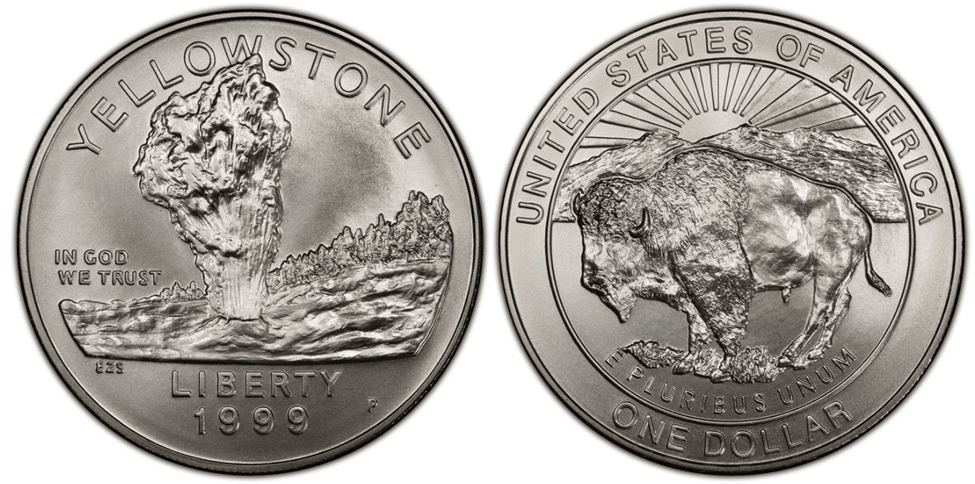
In 1997, the park celebrated the 125th anniversary of its opening, and two years later, Congress authorized the 1999 Yellowstone National Park Commemorative Silver Dollar for the occasion. Surcharges on the coins would be used by Yellowstone National Park and by the National Park Foundation.
Design & Mintage Details
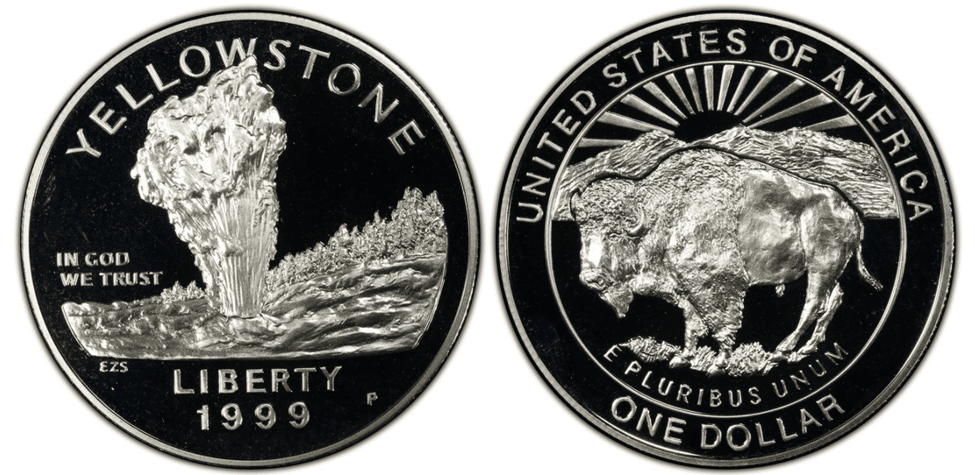
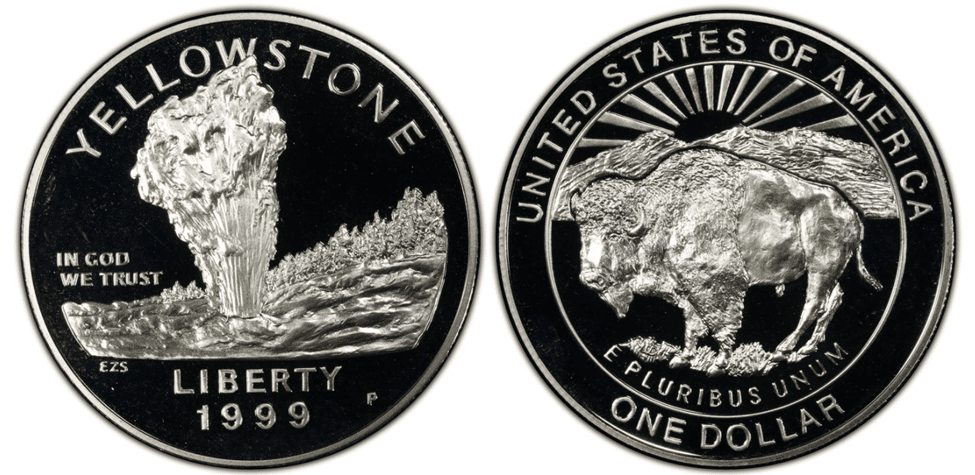
Coin designer Edgar Z. Steever designed the coin’s obverse, which depicts one of the park’s numerous geysers. While not identified on the coin as “Old Faithful,” which is one of the park’s most well-known attractions, it represents the numerous geysers there. To the left of the geyser are the words “IN GOD WE TRUST,” while below the geyser are “LIBERTY” and “1999”. The upper periphery has the name “YELLOWSTONE” in large font.
The reverse was adapted from the Department of the Interior’s seal and features an equally famous symbol of Yellowstone National Park – an American Bison. The Bison faces are left with the sun rising in the background above the mountains. Below the bison is “E PLURIBUS UNUM,” while the upper periphery has “UNITED STATES OF AMERICA,” and the lower periphery has the denomination “ONE DOLLAR.” William C. Cousins designed the reverse.
The 1999 Yellowstone National Park Commemorative Silver Dollar was issued in uncirculated and proof conditions, and both were minted at the Philadelphia Mint. The coins were sold individually and also as a two-coin set. The maximum authorized mintage was 500,000 silver dollars, and 82,563 uncirculated coins were sold, and 187,595 proof coins were sold.
Add this coin to your collection and view other U.S. silver modern commemorative coins.