
When defining “gold wafer,” readers encounter an immediate complication. In one context, a gold wafer may describe a very small, thin bullion product, often sold in sealed assay packaging and sometimes structured as a divisible or breakable sheet. In another, it refers to a silicon wafer coated with a thin gold layer for conductive or research applications. In still another, it is used loosely in jewelry, novelty, or collectible settings to describe ultra-thin decorative gold pieces. The meaning changes with the industry, and so does the value, purpose, and amount of gold involved.
In Bullion
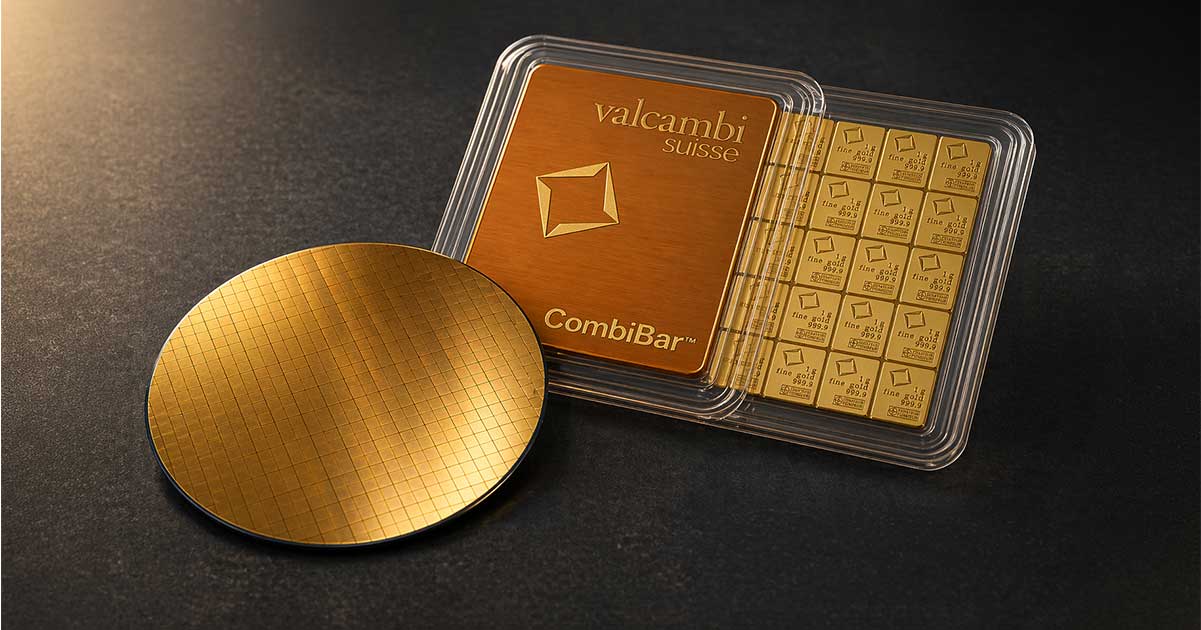
In precious metals investing, “gold wafer” is often an informal way to describe thin, small-format gold bars. These products are commonly minted in compact sizes, sealed in protective assay packaging, and marketed for flexibility, portability, and easy storage. A well-known example is the Valcambi CombiBar, a divisible investment bar made of .9999 pure gold that can be separated into smaller units. Valcambi describes its CombiBar as an investment bar available in multiple formats, including versions broken into detachable 1-gram sections.
This is the definition many bullion buyers have in mind when they picture a gold wafer. In this category, buyers may see product details such as purity, bar weight, refinery name, and packaging format emphasized more than artistic design. The appeal is practical. Smaller divisible bars can make it easier to own a wide range of fractional sizes without buying many separate pieces.
That said, “gold wafer” is not always a formal product category in bullion. Many retailers prefer terms like gold bars, minted bars, divisible bars, or combi bars. So, when reading listings, it is important to check whether the seller is using “wafer” as a casual description or referring to a specific branded product.
In Electronics and Manufacturing
Outside the bullion market, a gold wafer often refers to a silicon wafer coated with a thin film of gold. This type of material is used in electronics, nanotechnology, lithography, scientific research, and other technical applications where conductivity, surface chemistry, or deposition properties matter. To be specific, gold-coated silicon wafers are silicon wafers with gold deposited on the surface for micro and nanoscale patterning and other research uses. Some are silicon substrates coated with high-purity gold, often with a chromium or titanium adhesion layer between the silicon and gold film.
This distinction is important because the value proposition differs completely. In electronics, the wafer is not being purchased primarily as bullion. The gold layer may be extremely thin, and the product’s price reflects fabrication, coating thickness, substrate quality, and technical specifications rather than the melt value of pure gold alone. Someone comparing a gold-coated silicon wafer to investment-grade gold bars would therefore be comparing two entirely different products.
As Decorative Gold Pieces
There is a third, looser use of the phrase. In jewelry, collectibles, novelty items, or gift products, “gold wafer” can sometimes describe ultra-thin decorative gold pieces or thin stamped forms that are valued more for presentation than for bullion utility. This use is less standardized than the bullion or electronics definitions, which is exactly why potential buyers should be cautious. A decorative piece may contain gold, gold plating, or a very small amount of gold, but that does not make it equivalent to a recognized investment product. This is especially important for buyers who are focused on precious metals and assume the term automatically means a tradable bullion item.
How to Tell Which Definition Applies
The easiest way to understand a gold wafer is to look at the surrounding context. If the listing mentions assay packaging, refinery branding, bar weight, or divisible sections, it is probably referring to a bullion-style product. If it mentions silicon, adhesion layers, nanotechnology, or coating thickness measured in angstroms or nanometers, it is clearly an industrial wafer. If it emphasizes appearance, novelty, or ornament more than weight, purity, and refinery details, it is more likely being marketed as a decorative item rather than as standard bullion.
A useful comparison is a standard bullion listing, which presents details such as purity, packaging, and live-market pricing. That is very different from the way scientific suppliers describe gold-coated wafers by substrate diameter, layer thickness, and lab use.
The Real Answer Depends on You
The meaning of “gold wafer” depends on context. The most accurate approach is realizing that it depends on what one is trying to buy, study, or understand. In bullion contexts, it can refer to a thin, small-format gold product, sometimes a divisible bar, though the term is not used consistently across the market. In manufacturing, it means a silicon wafer with a thin gold coating for conductive or research purposes. In decorative contexts, it may simply mean a very thin gold piece with collectible or ornamental appeal. The same phrase can point to very different products, which is why your intent should always define the meaning first.