
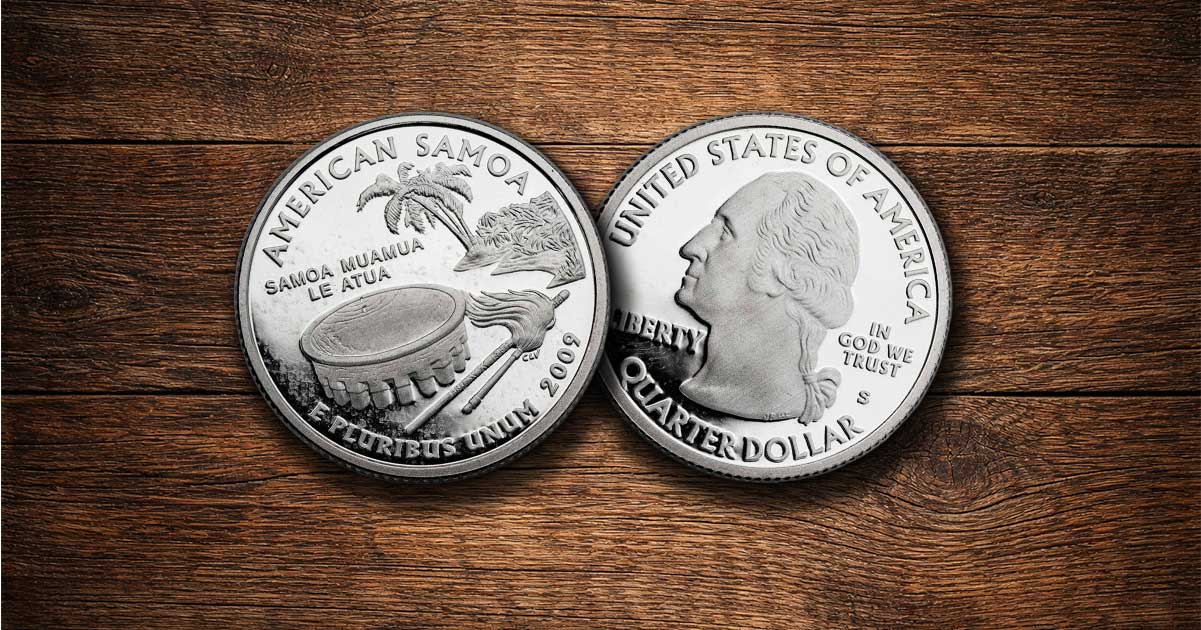
The American Samoa quarter was released in 2009 as part of the D.C. and U.S. Territories Quarters Program. While the American Samoa quarter is not known for a major headline-grabbing variety, a small number of documented mint-made errors and die varieties have been identified on the issue.
Design Details
The quarter features an ava bowl (“tanoa”), whisk, and staff with a coconut tree and shoreline in the background. The design honors important symbols of Samoan culture and includes the motto “Samoa Muamua Le Atua,” meaning “Samoa, God is First.” The ava bowl represents the preparation of a ceremonial drink served to chiefs and honored guests at important Samoan gatherings. The ava ceremony is one of the most important traditions in Samoan culture. The whisk and staff represent the authority and status of the Samoan orator who speaks during these ceremonies. The ava bowl, whisk, and staff are also featured on the Official Seal of American Samoa.
About American Samoa
American Samoa, often called the heart of Polynesia, consists of five volcanic islands and two coral atolls in the South Pacific. It lies about 2,300 miles southwest of Hawaii and roughly 2,700 miles northeast of Australia. European contact began in the early 18th century and increased during the 1830s as English missionaries and traders arrived. The United States gained rights to the area under the 1899 Treaty of Berlin, and American Samoa formally became a U.S. territory in 1929 after Congress approved deeds of cession from 1900 and 1904.
Struck-Through Grease Errors
Struck-through grease errors occur when grease or compacted debris fills recessed portions of the die before striking. When the coin is struck, the filled area prevents part of the design from transferring clearly.
Physical Diagnostics
- Weak or Missing Design Areas: Portions of the design may appear faint, smooth, or incomplete.
- Missing Initials or Lettering: On documented examples, the designer initials on Washington’s neck area may be weak or absent.
- No Metal Removal: The affected area should not show scraping, gouging, or signs that metal was removed after minting.
- Localized Weakness: The weakness usually appears in specific areas rather than across the entire coin.
Frequency
Struck-through grease American Samoa quarters are documented in certified examples. Known examples include 2009-P and 2009-D coins certified by ANACS.
Sintered Blank Errors
A sintered blank error occurs when a planchet has an abnormal surface caused by improper bonding, heating, or metal preparation before striking. This can create an unusual texture or color while still allowing the coin design to strike normally.
Physical Diagnostics
- Unusual Surface Texture: The coin may show a rougher or different-looking surface than a normal clad quarter.
- Abnormal Coloration: The surface may appear darker, duller, or otherwise different from a standard quarter.
- Normal Design Detail: The design should still appear struck into the coin rather than damaged after minting.
- Authentication Needed: Because surface problems can resemble environmental damage, certification is important.
Frequency
Sintered blank American Samoa quarters are rare but documented. A 2009-P American Samoa quarter struck on a sintered blank has been certified by ANACS.
Error Quarter Market Value
American Samoa quarter error values depend on rarity, condition, eye appeal, and proper attribution. Sintered blank errors and more obvious struck-through grease examples generally attract stronger collector interest than minor doubled die varieties. Properly attributed doubled die examples may still appeal to specialists who collect D.C. and U.S. Territories quarter varieties.
How to Identify Authentic American Samoa Quarter Errors
Collectors should inspect American Samoa quarters carefully under magnification, especially around Washington’s earlobe, the designer initials, lettering, rim, ava bowl, whisk, staff, and coconut tree. True doubled die features should be raised and should match known attribution points.
For struck-through grease errors, look for smooth, missing, or weakened design areas without scratches or gouges. For sintered blank errors, unusual texture or color alone is not enough, since environmental damage can look similar.
For valuable American Samoa quarter errors, comparison with certified examples from trusted numismatic references is recommended. While most circulated American Samoa quarters are common, documented struck-through grease errors, sintered blank errors, and attributed doubled die varieties continue to interest modern quarter collectors.