
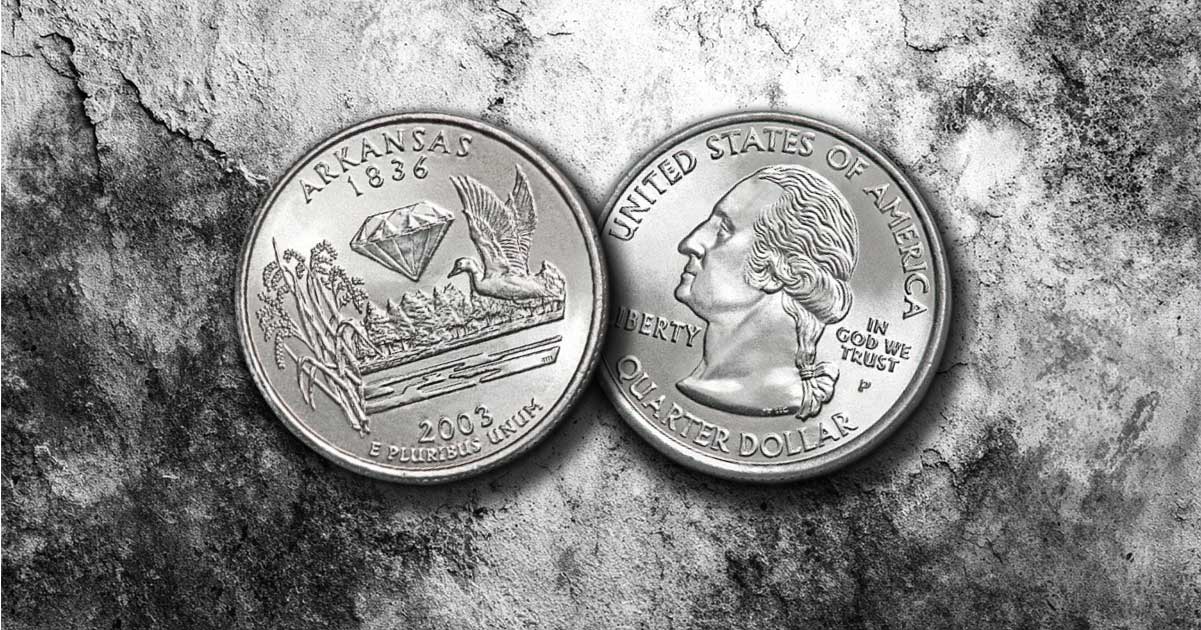
The Arkansas state quarter, released in 2003 as part of the U.S. Mint’s 50 State Quarters Program, features rice stalks, a diamond, and a mallard flying above a lake. While the Arkansas quarter is not known for one major mainstream error, several documented die varieties and mint-made errors have been identified on the issue.
Doubled Die Varieties
Some 2003-P Arkansas quarters are listed as doubled die obverse and doubled die reverse varieties. These are generally minor varieties that require magnification for proper attribution.
Physical Diagnostics
- Doubled Lettering: “LIBERTY” or “IN GOD WE TRUST” could be doubled on the quarter.
- Additional Tree-Top Detail: On certain documented reverse varieties, extra raised detail appears above portions of the tree line near the diamond design.
- Raised Secondary Detail: True doubled die features are raised and part of the struck design, not flat shelf-like machine doubling.
- Consistent Placement: Verified examples should match the known pickup points and die markers listed by attribution references.
Frequency
Arkansas doubled die varieties are documented, but they are generally minor and usually require magnification to identify. They are mainly collected by specialists who search state quarters for attributed die varieties.
Missing Clad Layer Errors
Missing clad layer errors occur when one of the outer copper-nickel layers is absent before the coin is struck. Since modern quarters are made with a copper core bonded between two outer clad layers, the missing layer exposes the copper beneath the surface.
Physical Diagnostics
- Copper-Colored Surface: One side of the coin may appear reddish, orange, or copper-brown instead of the normal silver-gray color.
- Reduced Weight: A quarter missing a clad layer should weigh less than a standard quarter.
- Visible Edge Contrast: The edge may show a clear difference between the remaining clad layer and the exposed copper core.
- Normal Strike Detail: The design should still appear struck into the coin rather than worn away, stained, or chemically altered.
Frequency
Certified Arkansas quarters with missing clad layers have appeared in third-party grading service holders and auction records.
Wrong Planchet Errors
One of the most dramatic documented Arkansas quarter errors is a certified 2003-P Arkansas quarter struck over an already-struck Roosevelt dime. This is a double-denomination error because a coin that had already been struck as a dime was later struck again by Arkansas quarter dies.
Physical Diagnostics
- Smaller Size: A dime is smaller than a quarter, so the Arkansas quarter design will not fit normally.
- Lower Weight: The coin should weigh much less than a standard quarter.
- Overlapping Designs: Details from the original dime may still be visible beneath or around the Arkansas quarter design.
- Incomplete Quarter Design: Portions of the date, lettering, rim, or reverse design may be missing because the host coin is too small.
Frequency
Arkansas quarters struck on struck dimes are extremely rare. Certified examples are major errors and are generally far more valuable than minor die varieties or common circulation finds.
Error Quarter Market Value
Arkansas quarter error values depend on rarity, condition, certification, and visual appeal. Properly attributed doubled die varieties may appeal most to state quarter variety specialists.
How to Identify Authentic Arkansas Quarter Errors
Collectors should inspect Arkansas quarters carefully under magnification, especially around Washington’s earlobe, the diamond, the tree line, lettering, and rim. True doubled die features should be raised and should match known attribution points.
A precision digital scale is helpful when checking possible missing clad layer errors or double-denomination pieces. Coins with unusual color should be evaluated carefully because toning, staining, environmental exposure, and chemical alteration are often mistaken for missing clad layers.
For valuable Arkansas quarter errors, comparison with certified examples from PCGS, NGC, or another established numismatic reference is recommended. While most circulated Arkansas quarters are common, these errors continue to interest modern state quarter collectors.