
The Centennial of Fort Vancouver
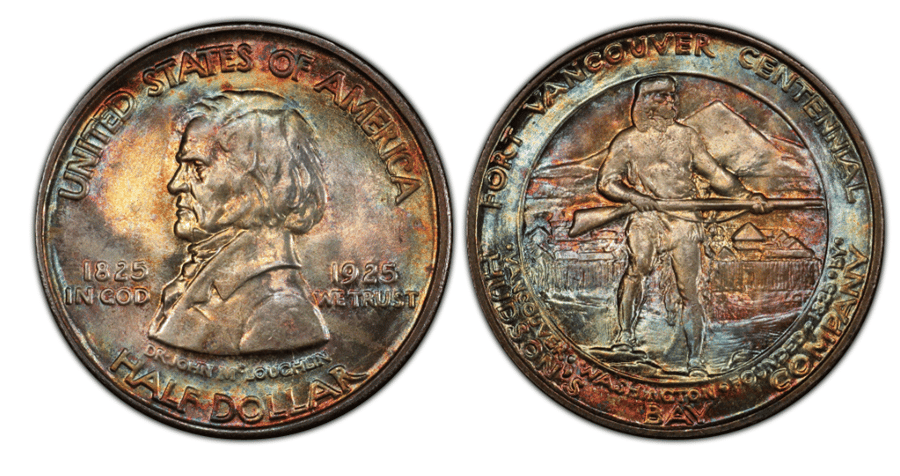
The 1925 Fort Vancouver Centennial Half Dollar marked the 100th anniversary of Fort Vancouver’s establishment in Vancouver, Washington. Although not a major national event, local interest and congressional support helped bring the proposal for this commemorative coin to Congress. The proceeds from the sale of this coin would help to defray the costs of the celebration in Vancouver.
The Washington representative who originally suggested this coin, Albert Johnson, was initially persuaded by committee leadership to accept a medal instead of a coin. However, when another congressman succeeded in amending a bill to include a commemorative coin for Fort Vancouver, that amendment ultimately passed.
Coin Design Details
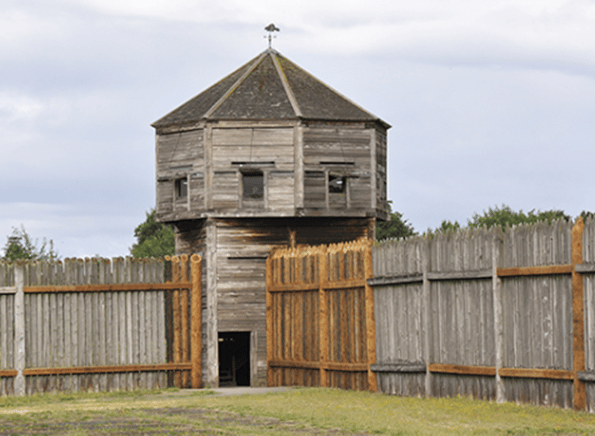
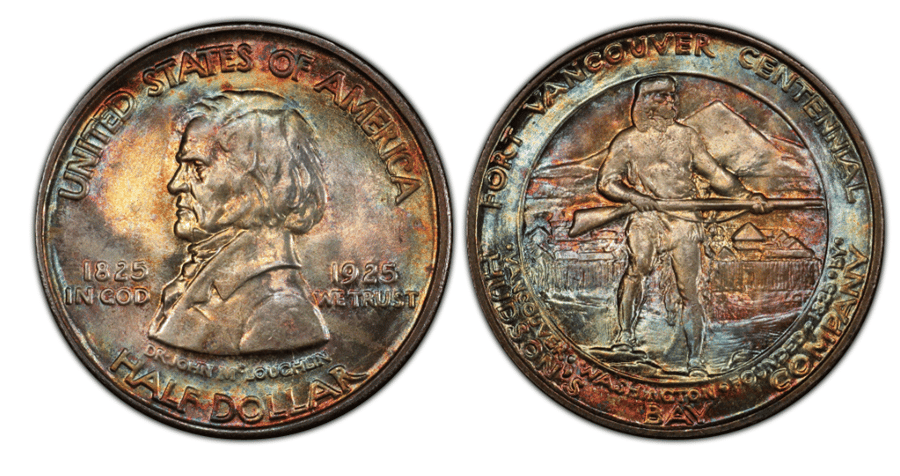
The Commission of Fine Arts recommended and brought on Laura Gardin Fraser to create the design for the 1925 Fort Vancouver Centennial Half Dollar. Fraser created another masterful design consisting of a portrait of Dr. John McLoughlin, who built Fort Vancouver in 1825. He worked for the Hudson’s Bay Company and was the chief factor at Fort Vancouver from its early establishment in 1825 until 1846. McLoughlin faces left, with “UNITED STATES OF AMERICA” above him on the top periphery and the denomination, “HALF DOLLAR” beneath him. Under the base of his portrait is his name, “DR. JOHN LOUGHLIN,” and his portrait separates “1825 1925” and “IN GOD WE TRUST.”
The reverse depicts a frontiersman with a rifle defending the fort in the background. Beyond the Fort is Mount Hood, a large mountain peak. Around the periphery of the reverse is “FORT VANCOUVER CENTENNIAL” above and “VANCOUVER – WASHINGTON – FOUNDED – BY – HUDSON’S BAY COMPANY” on two lines.
The dies were prepared at the Mint in Philadelphia and carefully shipped to the branch mint in San Francisco for striking. 300,000 coins were authorized by the Act passed by Congress, but only 50,000 coins were initially struck.
Lack of Funds & Low Sales
Although the coins were struck at the San Francisco Mint, they lack the ‘S’ mintmark because it was omitted during production. The celebration was not a World’s Fair, and traveling to Vancouver was not easy. The location, in 1925, was much more remote than it is today. Less than 15,000 coins (14,994) were sold and distributed when over 50,000 were struck, and over 35,000 coins were returned to the mint to be melted.
Unpaid debts and a lack of funds likely caused a tragedy. Charles A. Watts, secretary of the Centennial Corporation and a key figure behind the creation of the coin, took his own life. Watts told a meeting of the Fort Vancouver Centennial Corporation that there were funds enough to pay all debts and that designer Laura Gardin Fraser was not owed any money. But they discovered the following day that the Corporation had unpaid bills totaling $6,000, and that Mrs. Fraser’s $1,200 fee remained unpaid.
This coin remains an important example of early 20th-century commemorative U.S. Mint issues. Discover the splendor of numismatic treasures in our distinguished assortment of classic U.S. silver commemorative coins.