
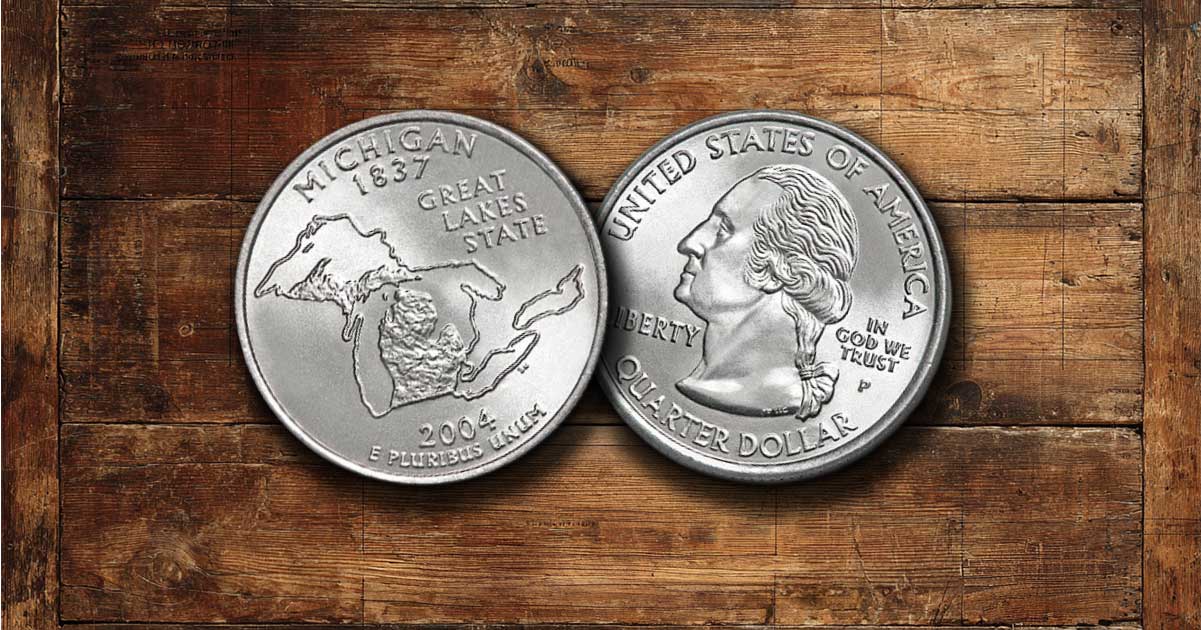
The Michigan state quarter, released in 2004 as part of the U.S. Mint’s 50 State Quarters Program, features an outline of the state surrounded by the Great Lakes system on the reverse. The reverse also includes the inscription “Great Lakes State,” highlighting Michigan’s connection to the largest group of freshwater lakes in North America. While the Michigan quarter is not known for a major headline-grabbing variety, a small number of documented die varieties and mint-made errors have been identified on the issue.
2004-P and 2004-D Doubled Die Obverse Varieties
Some Michigan quarters are listed as doubled die obverse varieties. Documented examples include both 2004-P and 2004-D Michigan quarters. These are minor varieties and usually require magnification to identify.
Physical Diagnostics
- Doubled Earlobe / Hairline Area: On many attributed State Quarter obverse doubled die varieties, doubling appears on/near Washington’s portrait and may require magnification to confirm.
- Raised Secondary Detail: A true doubled die shows raised doubling that is part of the struck design, not flat machine doubling.
- Obverse Location: The doubling appears on the Washington side of the coin rather than the Michigan reverse.
- Supporting Die Markers: Some attributed examples may include small die scratches, die gouges, or other markers that help confirm the variety.
Frequency
Michigan doubled die obverse varieties are documented, but they are not considered major dramatic doubled dies. They are mainly collected by specialists who search state quarters for attributed die varieties. Proper attribution is important because machine doubling, die wear, and contact marks can be mistaken for true doubled dies.
Broadstruck Out-of-Collar Errors
A broadstrike occurs when a coin is struck outside the retaining collar. The collar normally controls the coin’s diameter and helps form the edge. When the planchet is not properly contained, the metal can spread outward during striking.
Physical Diagnostics
- Expanded Diameter: The coin may appear wider than a normal quarter.
- Weak or Missing Rim: The normal raised rim may be incomplete, distorted, or absent.
- Out-of-Collar Appearance: The edge may look abnormal because the collar did not properly contain the planchet during striking.
- Full or Nearly Full Design: Many broadstruck coins still show most of the central design, even though the coin spread beyond its normal size.
Frequency
Broadstruck Michigan quarters are scarce but documented. Certified examples are known struck out of collar. Examples with obvious expansion and clear design detail are generally more collectible.
Missing Clad Layer Errors
Missing clad layer errors occur when one of the outer copper-nickel layers is absent before the coin is struck. Since modern quarters are made with a copper core bonded between two outer clad layers, the missing layer exposes the copper beneath the surface.
Physical Diagnostics
- Copper-Colored Surface: One side of the coin may appear reddish, orange, brown, or copper-toned instead of the normal silver-gray color.
- Reduced Weight: A quarter missing a clad layer should weigh less than a standard quarter.
- Visible Edge Contrast: The edge may show a difference between the remaining clad layer and the exposed copper core.
- Normal Strike Detail: The design should still appear struck into the coin rather than worn away, stained, or chemically altered.
Frequency
Missing clad layer Michigan quarters are scarce but documented. Certified examples with missing clad layers have appeared in grading service holders and auction records.
Off-Center Strike Errors
Off-center strikes occur when the planchet is not properly aligned between the dies during striking. This causes only part of the design to transfer onto the coin.
Physical Diagnostics
- Blank Crescent Area: A smooth, unstruck section appears along one side of the coin.
- Missing Design Elements: Portions of the date, lettering, the state outline, or Great Lakes design may be absent.
- Sharp Remaining Detail: The struck portion should still show clear design detail.
- Shifted Design Placement: The design appears displaced from the center of the coin.
Frequency
Off-center Michigan quarters are documented but scarce. Examples retaining the full date while showing significant displacement are generally the most collectible.
Error Quarter Market Value
Michigan quarter error values depend on rarity, condition, eye appeal, and proper authentication. Broadstruck, off-center, and missing clad layer examples generally attract more collector interest than minor doubled die varieties because the errors are easier to recognize. Properly attributed doubled die obverse examples may still carry premiums among state quarter variety specialists, especially in higher grades.
How to Identify Authentic Michigan Quarter Errors
Collectors should inspect Michigan quarters carefully under magnification, especially around Washington’s earlobe and nearby hairlines, the rim, lettering, and the Great Lakes design. True doubled die features should be raised and should match known attribution points.
For broadstrike errors, examine the rim and overall shape of the coin. A genuine broadstrike should show mint-made expansion rather than filing, cutting, or post-mint damage.
A precision digital scale can help identify possible missing clad layer errors because these coins weigh less than standard quarters. Coins with unusual color should be examined carefully because toning, staining, environmental exposure, and chemical alteration are often mistaken for missing clad layers.
Because many altered or damaged coins are mistaken for mint errors, comparison with certified examples from PCGS, NGC, ANACS, or another established numismatic reference is recommended. While most circulated examples are common, certified broadstrike errors, off-center strikes, missing clad layer errors, and properly attributed doubled die obverse varieties continue to interest modern state quarter collectors.