
Baldwin and Company’s Four Gold Coins
Baldwin and Company were well-known jewelers operating in San Francisco before and during the California Gold Rush. Sensing an opportunity to profit from the shortage of gold coins in circulation, Baldwin purchased the coining operation of F.D. Kohler in March of 1850.
Baldwin was among the first mints to issue lower-denomination gold coins, which were sorely needed. Baldwin struck $5, $10, and $20 private gold coins, which were much more useful in everyday commerce than the $50 large “slugs” that others had focused upon.
Coin Details
Over 1850 and 1851, Baldwin & Co. struck 4 different coins:
- 1850 $5
- 1850 $10
- 1851 $10
- 1851 $20
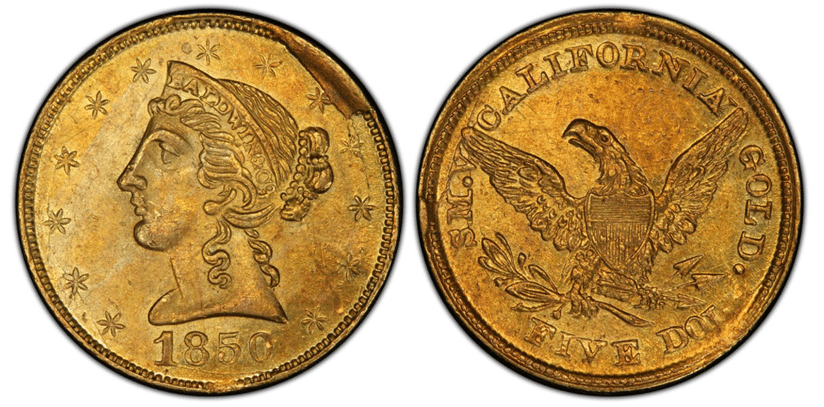
The 1850 $5.00 Baldwin gold coin depicted Lady Liberty on the obverse, facing left, surrounded by 13 six-pointed stars. At the bottom of the obverse, periphery was the date “1850.” On Lady Liberty’s coronet is “BALDWIN & CO.”
The reverse had an eagle with up-spread wings, holding an olive branch and three arrows in its talons, a shield covering its breast with “S. M. V. CALIFORNIA GOLD. FIVE DOL.” around the periphery.
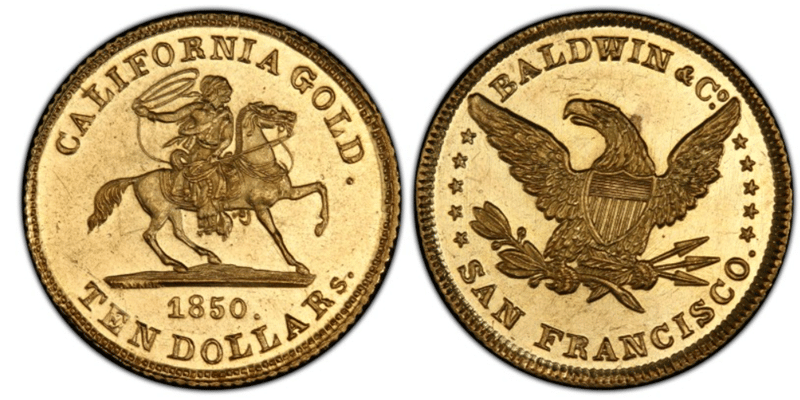
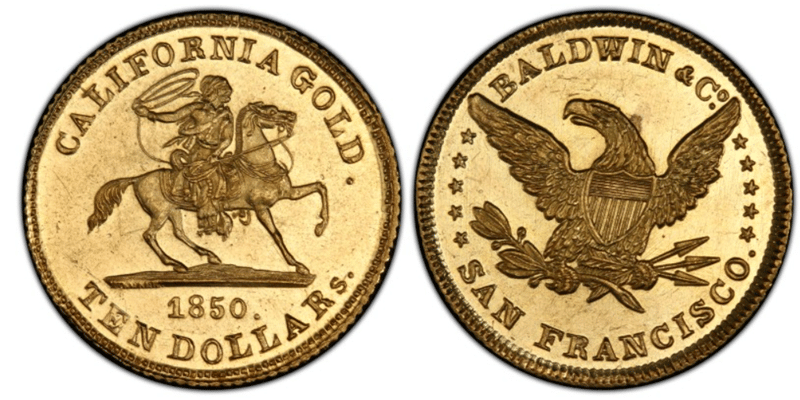
The next coin struck was an 1850-dated $10 gold coin, but its style was very different. The obverse had a horseman on his steed, using a lariat. The date 1850 was underneath them, and around the periphery was “CALIFORNIA GOLD. TEN DOLLARS.”
The reverse has a large eagle with wings upwards, again holding an olive branch and arrows in its talons. Between his wings, along the periphery, is “BALDWIN & Co.” surrounded on each wide 5 five-pointed star, and on the bottom periphery is “SAN FRANCISCO.”
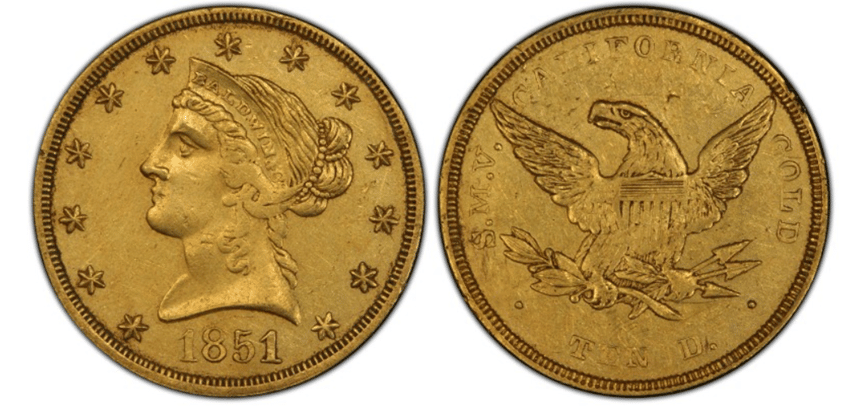
The next gold coin struck by Baldwin & Company was a 1851-dated $10.00 Gold coin. It reverted to the original first $5.00 coin design, with the only differences being the date on the obverse, “1851,” and the denomination on the reverse, “ TEN D.”
The final coin that was struck was a 1851 $20.00 gold coin. It is identical to the 1851 $10.00, except that the size is larger and the reverse bears the new denomination “TWENTY D.”
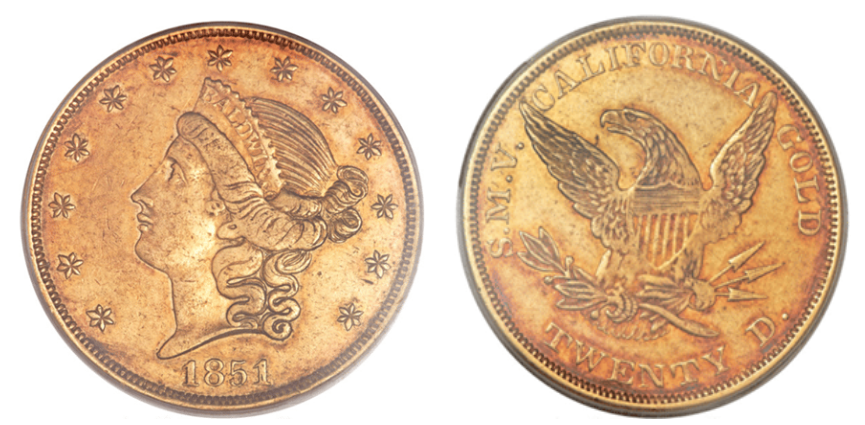
(An 1851 Baldwin & Co, $20 Gold Coin, Obverse [left], Reverse [right].)
The Fall of Baldwin & Company
But in March, several Baldwin & Co. coins were submitted to Augustus Humbert for assay, and the submitter had the findings published in local San Francisco newspapers. People were shocked to learn that the $20.00 gold coin was assayed at $19.40 worth of gold, the $10.00 gold coin assayed at $9.74, and the $5.00 gold coin assayed at $4.91, which meant that all of the coins were under their face value and only the $5.00 coin should be accepted as the discrepancy was trivial.
Now, the confidence in the Baldwin & Company gold coins had nearly completely evaporated. The coins were now starting to disappear from all circulation. Baldwin denied the Assayer’s report and even published one from another Assayer, F. D. Kohler. Baldwin also claimed that their rival minter, Moffat & Company, was behind the discredit of Baldwin. But all protests were to no avail; the damage had been done.
Merchants, looking to continue to profit from this “bad news,” only accepted Baldwin and Company coins at steep discounts. After having them assayed, the merchants kept the profits for themselves. Some of the Baldwin coins were melted and re-struck as U.S. Assay Coins. By the end of the year, few Baldwin gold coins were found anywhere in circulation. Expand your collection with these coins today and shop our assortment of California fractional and territorial gold coins.