
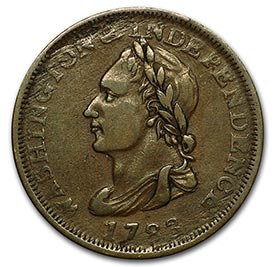
Washington Coins and Tokens in Early American Commerce
In the decades surrounding the American Revolution, everyday commerce in the United States ran on a patchwork of money. Foreign silver, British copper, state issues, and private tokens often circulated side by side. Against that backdrop, George Washington became a widely used symbol for engravers and entrepreneurs. A wide range of Washington pieces emerged, ranging from late 18th-century medallic issues to later tokens collected alongside colonial material because they feature early American national symbolism.
What follows is a practical, collector-oriented summary of the best-known Washington coins and tokens commonly grouped with colonial and early federal era numismatics, including their basic designs, why they were produced, and what makes them scarce. For additional information on each piece, links to individual Knowledge Center articles for each issue are provided.
Why So Many Washington Pieces Exist
The early federal government needed small change, but official copper coinage was slow to appear in volume. Private issuers filled gaps with tokens that were close enough in size and weight to circulate, or that functioned as advertising, commemoratives, and presentation pieces. Washington’s image provided immediate recognition, but it also created controversy. Washington famously resisted having his portrait on official coinage, viewing it as too monarchial for a republic. That tension helps explain why many Washington pieces are patterns, tokens, or unofficial issues rather than regular federal coins.
1783 to 1784: Unity and Satire
Washington “Unity States” Token (1783)
One of the best-known Washington-associated pieces grouped with colonial material is the 1783-dated “Unity States” Token. Although dated 1783, standard references note it was likely struck later than that date, making it a Washington-themed token collected with early American material rather than a confirmed immediate postwar issue.
Washington “Ugly Head” Satirical Token (1784)
By contrast, the “Ugly Head” Token is often described as satirical, though its intent is debated. The crude portrait may reflect an engraver working without an accurate likeness rather than deliberate mockery.
1791: The Washington Cents That Washington Rejected
The 1791 Washington Cents are central to the Washington colonial series because they look like what a national cent might have been, even though they were not adopted. They are usually associated with attempts to interest American officials in a ready-made copper coinage.
Large Eagle Cent (1791)
The large eagle variety pairs a military bust of Washington with a bold, heraldic eagle reverse. Key diagnostics include the “WASHINGTON” and “PRESIDENT” peripheral inscriptions and the prominent eagle motif intended to read as unmistakably American.
Small Eagle Cent (1791)
The small eagle type keeps the same basic Washington concept but uses a different reverse eagle style and overall design approach. Collectors often treat the Large and Small Eagle Cents as the two main pillars of the 1791 group, with related die trials and mulings existing as important adjuncts.
1792: Expanding the Washington Pattern and Token Family
If 1791 represents early proposals, 1792 saw a rapid increase in Washington-related patterns and related issues.
Washington Cents (1792)
The 1792 Washington Cents continue the Washington portrait concept, with varieties that include large eagle style reverses and issues struck in different metals. These are commonly treated as great rarities, with extremely small surviving populations for certain formats and compositions.
Washington “Roman Head” (1792)
The “Roman Head” type is collected as a distinctive portrait style within the broader 1792 Washington family. The appeal is largely typological: the portrait treatment differs sharply from the more familiar military bust look seen on other Washington pieces.
Washington “President, Born Virginia” (1792)
Another branch of the 1792 material emphasizes text and biography rather than an eagle reverse. The “Born Virginia” theme and related legend-heavy reverses list milestones such as Washington’s military leadership and presidency. A key point for collectors is that edge varieties matter, including plain and lettered edges, and that certain metallic formats are effectively trophy-level rarities.
Washington-Getz Patterns (1792)
The Getz patterns are notable because they are tied to an American engraver and a more formal pattern context rather than a purely commercial British token motive. The basic format still centers Washington’s bust, but the series is collected as a distinct, organized pattern group with both copper and silver versions attributed to congressional-era decision making.
1790s: Washington Mulings and Commercial Tokens in Circulation
By 1793, Washington imagery was being paired with other commercial token reverses to create pieces that could circulate as practical small change.
Washington Ship Halfpenny (1793)
The Washington Ship Halfpenny is a classic Washington mules issue: a Washington obverse paired with a ship reverse dated 1793 and intended to function at roughly halfpenny size. Collectors focus heavily on the edge, because the plain edge variety is dramatically rarer than the more available lettered edge version.
Washington Grate Token (1795)
The Washington Grate Token is another Washington portrait token associated with a commercial issuer, with a reverse depicting a fireplace grate motif and issuer legends. It is collected both as a Washington piece and as part of the broader late 18th-century token economy tied to British manufacture and transatlantic circulation.
Washington “Success” Medals and Tokens
The Washington “Success” pieces are unusual because their origin and purpose have been debated for generations. They are known for a Washington bust paired with an Eye of Providence and starburst-themed reverse carrying the legend “SUCCESS TO THE UNITED STATES,” and for existing in multiple sizes and compositions. Collectors tend to treat them as a separate specialty within Washington exonumia because attribution questions, die varieties, and edge types are central to the series’ identity.
1795: Late 1790s Commercial Tokens With Washington’s Portrait
Liberty and Security Tokens (1795)
The Liberty and Security Tokens are typically associated with Birmingham manufacture and the recurring “contract pitch” idea: private makers hoping to demonstrate what American coinage could look like, even while repeating the portrait-of-Washington problem that made official adoption unlikely. Collectors organize the series by size, date presence, and edge inscriptions, with multiple distinct varieties known.
North Wales Halfpenny (1795)
The North Wales Halfpenny is another Washington portrait token with a crowned harp reverse theme and notable legend quirks that attract variety collectors. As with many Washington tokens, scarcity can vary dramatically by composition and edge type, so attribution and authentication are essential.
Collecting Considerations
Across all these Washington coins and tokens, three practical rules show up repeatedly:
- Edge matters. Plain edge versus lettered edge can mean the difference between “collectible with patience” and “major rarity.”
- Die varieties define the series. Many of these issues are collected by major design subtype rather than by a single date alone.
- Condition is complicated. A number of Washington tokens circulated hard, while others survive in prooflike or lightly handled states. Strike quality and planchet quality can matter as much as wear.
Taken together, Washington tokens illustrate the early development of American money: a young nation with limited official coinage, widespread patriotic symbolism, and private enterprise supplying pieces that circulated alongside official issues.